
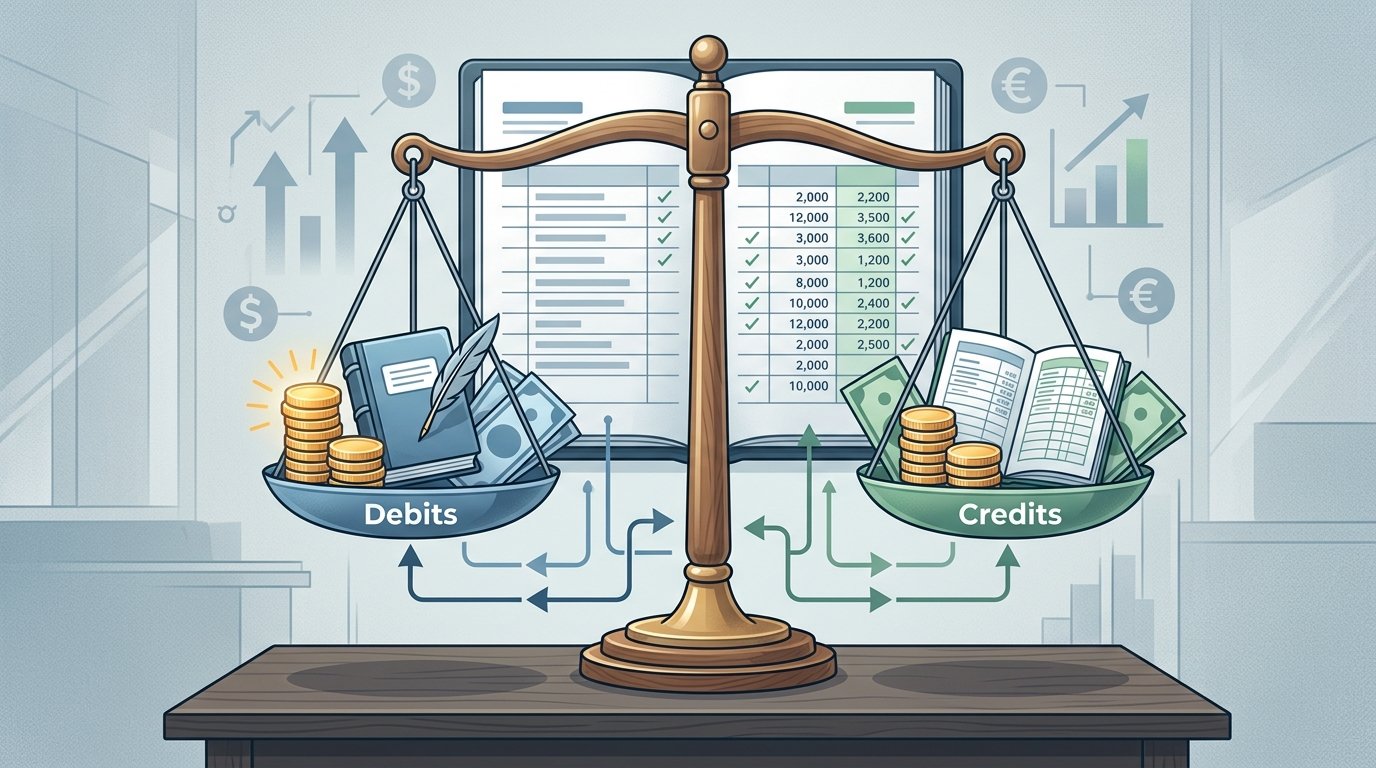
Fundamentals of Debits, Credits, and the Double-Entry System
Every financial transaction includes two entries that balance each other. The system uses the accounting equation and clear rules for debits and credits.
Origins and Principles of the Double-Entry Accounting System
Double-entry accounting ensures that every transaction affects at least two accounts. When companies record financial events, they make sure total debits equal total credits.
Luca Pacioli developed this system to improve accuracy in financial records. Each transaction has two sides that offset each other.
For example, when a business borrows $5,000 from a bank, it increases Cash and increases Notes Payable. Both accounts change by $5,000.
This method helps catch errors because the books will not balance if entries are incomplete or incorrect. The double-entry approach keeps the accounting equation balanced after every transaction.
Companies may have a few dozen or thousands of accounts in their chart of accounts. All accounts follow the same rules for debits and credits.
The Meaning of Debit and Credit in Financial Records
A debit is an entry on the left side of an account. A credit is an entry on the right side.
Debits and credits do not always mean increase or decrease. Whether a debit or credit increases an account depends on the account type.
Accounts increased by debits:
- Assets
- Expenses
- Dividends or Draws
- Losses
Accounts increased by credits:
- Liabilities
- Equity
- Revenues or Income
- Gains
To decrease an account, use the opposite entry. If a debit increases an asset, a credit decreases it.
When a company receives cash, it debits the Cash account. When it pays out cash, it credits the Cash account.
The abbreviation for debit is “dr.” and for credit is “cr.” These abbreviations come from Latin.
Structure and Purpose of the Accounting Equation
The accounting equation is Assets = Liabilities + Equity. This equation must stay balanced after every transaction.
Assets appear on the left side of the equation. Liabilities and equity appear on the right side.
When companies record debits and credits correctly, both sides of the equation stay equal. Each account has a normal balance.
Asset accounts usually have debit balances. Liability and equity accounts usually have credit balances.
Revenue accounts have credit balances, while expense accounts have debit balances.
When accountants create journal entries, they make sure debits always equal credits. For example, if a company receives $500 from a customer, it debits Cash for $500 and credits Accounts Receivable for $500.
This process helps catch errors. If debits do not equal credits, the books do not balance and the mistake is easy to spot.
Classifying and Understanding Account Types
Every account falls into one of five main categories, each with its own rules for debits and credits. Assets, liabilities, and equity accounts appear on the balance sheet, while revenues and expenses appear on the income statement.
Asset, Liability, and Equity Accounts
Asset accounts show what a company owns. Examples include Cash, Accounts Receivable, Inventory, Equipment, and Prepaid Rent.
These accounts usually have debit balances. When a business acquires an asset, it debits the asset account to increase it.
Liability accounts show what a company owes. Accounts Payable, Notes Payable, and Wages Payable are common examples.
These accounts usually have credit balances. A credit increases a liability, and a debit decreases it.
Equity accounts show the owner’s share in the business. For sole proprietorships, this includes the Owner’s Capital account and Owner’s Drawing account.
Corporations use Stockholders’ Equity, Retained Earnings, and Common Stock accounts. Most equity accounts have credit balances and increase with credits.
Asset, liability, and equity accounts are permanent accounts. Their balances carry forward from one period to the next.
A $10,000 balance in Equipment on December 31 remains in that account on January 1.
Revenue and Expense Accounts
Revenue accounts show income earned from business operations. Examples include Service Revenues, Sales, and Interest Income.
These accounts usually have credit balances. When a company earns revenue, it credits the revenue account.
Expense accounts show the costs of running a business. Examples include Rent Expense, Salaries Expense, Wages Expense, Supplies Expense, and Interest Expense.
Expenses have debit balances and increase with debits. Revenue and expense accounts are temporary accounts.
At the end of the year, their balances move to equity accounts through closing entries. This resets all temporary accounts to zero for the new year.
Contra Accounts and Their Normal Balances
Contra accounts have balances opposite to their related account type. They provide more detailed financial information and reduce the value of their associated main accounts.
Sales Returns, Sales Allowances, and Sales Discounts are contra revenue accounts. These accounts carry debit balances and reduce total sales revenue.
Accumulated Depreciation is a contra asset account. It pairs with asset accounts like Equipment or Buildings but has a credit balance.
This account shows how much of an asset’s cost has been depreciated over time.
T-Accounts and Visualizing Transactions
T-accounts help track how transactions affect specific ledger accounts. Debits always appear on the left side, and credits on the right side of the “T.”
Introduction to T-Accounts and Ledger Accounts
A T-account is a tool shaped like the letter “T” that shows individual accounts in the general ledger. The account name sits at the top, and the vertical line divides the account into two sides.
Every general ledger account can be shown as a T-account. This includes asset accounts like cash, liability accounts like accounts payable, and equity accounts like common stock.
The T-account format makes it easy to see increases and decreases in a specific account.
Accountants use T-accounts to track journal entries and calculate balances. When a transaction occurs, they post the amounts to the correct T-accounts.
The bottom of each T-account shows the total balance by finding the difference between the two sides.
Understanding Debit Side and Credit Side Movements
The left side of every T-account is the debit side, and the right side is the credit side. This never changes, no matter the account type.
For asset accounts, debits on the left side show increases, and credits on the right side show decreases.
For liability and equity accounts, debits decrease and credits increase these accounts.
Revenue accounts increase with credits and decrease with debits. Expense accounts increase with debits and decrease with credits.
This structure keeps every transaction balanced.
For example, when a company issues stock for $500,000, it debits the cash T-account for $500,000 and credits the common shares T-account for $500,000.
Rules and Patterns: When to Debit, When to Credit
Each account type has rules for increasing or decreasing with debits or credits. Assets and expenses increase with debits. Liabilities, equity, and revenues increase with credits.
Debit and Credit Rules for Different Account Types
Assets increase with debits and decrease with credits. When a company receives cash or buys equipment, it debits the asset account.
Liabilities increase with credits and decrease with debits. When a business borrows money, it credits the liability account.
Equity accounts increase with credits and decrease with debits. Owner’s equity and stockholders’ equity follow this rule.
Revenue accounts increase with credits. When a company earns income from sales or services, it credits the revenue account.
Expenses increase with debits. Rent expense, wages expense, and supplies expense all increase on the debit side.
Normal balances for each account type:
| Account Type | Increases With | Decreases With | Normal Balance |
|---|---|---|---|
| Assets | Debit | Credit | Debit |
| Liabilities | Credit | Debit | Credit |
| Equity | Credit | Debit | Credit |
| Revenues | Credit | Debit | Credit |
| Expenses | Debit | Credit | Debit |
Mnemonic Devices for Remembering Increases and Decreases
The acronym DEALER helps you remember which accounts increase with debits. It stands for Dividends, Expenses, Assets, Losses, and Returns.
GIRLS helps remember accounts that increase with credits: Gains, Income, Revenues, Liabilities, and Stockholders’ equity.
A simple rule for cash: debit the cash account when receiving cash and credit it when paying out cash. This works because cash is an asset, and assets increase with debits.
Accounts on the left side of the accounting equation (assets) increase with left-side entries (debits). Accounts on the right side (liabilities and equity) increase with right-side entries (credits).
Recording Transactions: From Journal Entries to Financial Statements
Every financial transaction moves from initial recording to final reporting. Journal entries start the process, and the trial balance checks the totals before creating the balance sheet and income statement.
The Process of Creating and Posting Journal Entries
A journal entry records each business transaction by identifying which accounts change and applying debit and credit rules.
The entry includes the date, account names, amounts, and a short description. The account receiving the debit is listed first, and credited accounts appear below and are usually indented.
Bookkeepers post these journal entries to the general ledger accounts. Accounting software often automates this process, but the logic stays the same.
Each posted entry updates account balances and keeps a record of every financial change.
The chart of accounts determines which accounts to use for each entry. For example, if a company receives payment from a customer, it debits Cash and credits Accounts Receivable.
This process creates a permanent record that can be traced from the original journal entry to the financial statements.
Sample Transactions Across Different Account Types
Cash received for services rendered:
- Debit: Cash $500
- Credit: Service Revenue $500
Payment of monthly rent:
- Debit: Rent Expense $1,200
- Credit: Cash $1,200
Purchase of supplies on credit:
- Debit: Supplies $300
- Credit: Accounts Payable $300
Receipt of bank statement showing interest earned:
- Debit: Cash $25
- Credit: Interest Income $25
These examples show how different account types interact when recording transactions.
Asset accounts like Cash increase with debits and decrease with credits.
Revenue accounts grow with credits.
Expense accounts increase with debits.
Each transaction keeps the books balanced by ensuring debits equal credits.
The Role of the Trial Balance and Audit Trail
The trial balance lists all account balances at a specific time.
Debits appear in one column, and credits appear in another.
This report checks that total debits equal total credits before preparing financial statements.
If the trial balance does not balance, it signals an error in recording transactions or posting journal entries.
The audit trail tracks every step from the original transaction to the final financial statement.
This record includes source documents, journal entries, ledger postings, and adjustments.
Companies use the audit trail to check accuracy and find discrepancies.
It also provides evidence during audits.
Financial statements use balanced accounts as their source.
The income statement shows revenue and expense accounts.
The balance sheet lists assets, liabilities, and equity.
Properly recorded journal entries and a balanced trial balance help prevent errors in these statements.
Common Ledger Accounts and Real-World Examples
Every business uses specific accounts to track financial activity.
These accounts fall into categories like assets, liabilities, revenues, and expenses.
Each one follows clear debit and credit rules based on its type.
Assets: Cash, Accounts Receivable, and Prepaid Expenses
Asset accounts increase with debits and decrease with credits.
The cash account tracks all money a business receives and pays out.
When a company receives $1,000 from a customer, it debits Cash for $1,000.
When it pays $300 for supplies, it credits Cash for $300.
Accounts receivable shows money customers owe the business.
If a company provides a $500 service and lets the customer pay later, it debits Accounts Receivable for $500.
When the customer pays, the business debits Cash and credits Accounts Receivable.
Prepaid expenses are payments made in advance for future benefits.
When a business pays $1,200 for a yearly insurance policy, it debits Prepaid Expenses.
Each month, as insurance is used, the business credits Prepaid Expenses and debits Insurance Expense for $100.
Liabilities: Accounts Payable and Notes Payable
Liability accounts increase with credits and decrease with debits.
Accounts payable tracks money the business owes to suppliers for goods or services bought on credit.
When a company buys $800 of office supplies on credit, it credits Accounts Payable for $800.
When it pays the supplier, it debits Accounts Payable and credits Cash.
Notes payable and loan payable show formal borrowing agreements with lenders.
If a business borrows $10,000 from a bank, it debits Cash and credits Notes Payable for $10,000.
When the business makes a $1,000 loan payment, it debits Notes Payable for the principal and credits Cash.
Any interest portion goes to Interest Expense.
Revenue: Sales and Service Revenues
Revenue accounts increase with credits and decrease with debits.
Sales revenue tracks income from selling products.
When a store sells merchandise for $750 cash, it debits Cash and credits Sales Revenue for $750.
If the store sells $400 of goods on credit, it debits Accounts Receivable and credits Sales Revenue.
Service revenues record income from providing services.
A consulting firm that completes a $2,000 project and bills the client debits Accounts Receivable and credits Service Revenues for $2,000.
When the client pays later, the firm debits Cash and credits Accounts Receivable.
Credit the revenue account when the business earns income, even if cash is received later.
Expenses: Rent, Salaries, and Interest
Expense accounts increase with debits and decrease with credits.
Rent expense tracks payments for using property or equipment.
When a business pays $2,500 for monthly rent, it debits Rent Expense and credits Cash.
If the business pays July rent in June, it debits Prepaid Expenses and transfers it to Rent Expense in July.
Salaries expense records employee pay.
If employees earn $5,000 in a pay period, the business debits Salaries Expense and credits Cash when it pays them.
If employees work the last week of December but get paid in January, the business debits Salaries Expense and credits Salaries Payable.
Interest expense shows the cost of borrowing money.
When a business pays $150 in loan interest, it debits Interest Expense and credits Cash.
Cost of goods sold tracks the direct cost of products sold and is debited when the business recognizes the expense.
Adjustments, Closing Entries, and Maintaining Financial Balance
Account balances need regular updates to show the true financial position.
Closing entries transfer temporary account balances to permanent accounts at period-end.
These steps match revenues and expenses to the correct period and make sure debits always equal credits.
Temporary vs. Permanent Accounts in the Closing Process
Temporary accounts track financial activity for a single period and reset to zero at the end.
Revenue accounts, expense accounts, and the income summary account are temporary accounts.
These accounts close at year-end to prepare for the next period.
Permanent accounts carry balances forward from period to period.
Assets, liabilities, and equity accounts stay open and accumulate balances over time.
Retained earnings, a permanent account, receives net income or loss transferred from temporary accounts.
The closing process uses the income summary account as an intermediate step.
First, close all revenue accounts with debits that offset their credit balances and credit income summary.
Then, close expense accounts with credits that offset their debit balances and debit income summary.
After these entries, income summary shows either a credit balance (net income) or a debit balance (net loss).
The final closing entry transfers this balance to retained earnings and zeros out income summary.
Each closing entry keeps debits and credits balanced.
Handling Accumulated Depreciation and Allowances
Accumulated depreciation acts as a contra-asset account with a credit balance that reduces the value of fixed assets.
When the business records depreciation expense, it debits depreciation expense and credits accumulated depreciation.
The accumulated depreciation account is permanent and grows over time.
The allowance for doubtful accounts works in a similar way as a contra-asset that reduces accounts receivable.
When the business increases this allowance, it debits bad debt expense and credits the allowance account.
Only the change in the allowance affects the income statement.
| Account Type | Normal Balance | Impact on Balance Sheet |
|---|---|---|
| Accumulated Depreciation | Credit | Reduces asset value |
| Allowance for Doubtful Accounts | Credit | Reduces receivables |
These contra accounts do not close during the closing entry process because they are permanent.
They remain until the related asset is sold or written off.
Revenue Returns, Allowances, and Discounts
Sales returns and allowances reduce gross revenue when customers return products or receive price reductions.
The sales returns and allowances account carries a debit balance as a contra-revenue account.
When recording a return, debit sales returns and allowances and credit accounts receivable or cash.
Sales discounts reduce the amount owed for early payment and also function as contra-revenue with a debit balance.
If a customer pays within discount terms, debit sales discount and cash, and credit accounts receivable for the original amount.
Unearned revenue tracks payments received before services are delivered.
This liability account starts with a credit when cash is received.
As the company earns the revenue, debit unearned revenue and credit revenue.
This adjustment records revenue in the correct period for tax and reporting purposes.
All contra-revenue accounts close at period-end with revenue accounts.
The closing entry debits the main revenue account and credits contra-revenue accounts, then transfers the net amount to income summary.
Frequently Asked Questions
Debits and credits form the foundation of accounting.
These answers explain how debits and credits work to keep financial records accurate.
What do debit and credit mean in double-entry accounting?
A debit is an entry on the left side of an account.
A credit is an entry on the right side.
These terms do not always mean “increase” or “decrease” but show position in the records.
Bookkeepers use debits and credits to record how money or value moves in each transaction.
Every business event needs at least one debit and one credit to different accounts.
This method gives a clear picture of how transactions affect finances.
“Debit” comes from a Latin word meaning “he owes,” and “credit” comes from “he trusts.”
These origins relate to tracking obligations in early commerce.
Why must every debit be matched by an equal credit in a transaction?
Matching debits and credits keeps the accounting equation balanced.
The accounting equation is Assets = Liabilities + Equity.
When a transaction changes one side, it must also change the other side or another part of the same side by the same amount.
This rule prevents errors in financial records.
If debits and credits do not match, the books will not balance and a mistake has likely occurred.
This system also creates an audit trail, making it easier to find fraud or errors.
When every debit links to a credit, accountants can trace each transaction for accuracy.
How do debits and credits affect assets, liabilities, and equity on the balance sheet?
Assets increase with debits and decrease with credits.
When a company receives cash or buys equipment, the accountant debits the asset account.
Liabilities and equity increase with credits and decrease with debits.
When a company borrows money, the liability account receives a credit.
This opposite relationship keeps the accounting equation balanced.
If an asset increases with a debit, something else must change to keep both sides equal.
That change might be an increase in liabilities through a credit or a decrease in another asset through a credit.
The owner’s equity section follows the same rules as liabilities.
Capital contributions receive credits.
Owner withdrawals receive debits.
What is the correct way to record debits and credits in a journal entry?
A journal entry lists the date first, then the accounts affected.
Debit entries appear first, aligned to the left.
Credit entries appear below the debits and are indented to the right.
Each debit and credit includes the account name and dollar amount.
Total debits must equal total credits before the entry is complete and can be posted to ledger accounts.
Most transactions use two accounts, but some use three or more.
A loan payment, for example, includes debits to loan payable and interest expense, and a credit to cash for the total payment.
The journal entry includes a short description explaining the business purpose.
How can you tell whether an account will have a debit balance or a credit balance in the ledger?
The normal balance of an account depends on its type.
Asset accounts, expense accounts, and dividend or draw accounts usually have debit balances.
These accounts increase with debits and decrease with credits.
Liability accounts, equity accounts, and revenue accounts usually have credit balances.
These accounts increase with credits and decrease with debits.
The normal balance is the side where increases are recorded.
A helpful memory tool is DEAL for normal debit balances: Dividends, Expenses, Assets, and Losses.
GIRLS stands for normal credit balances: Gains, Income, Revenues, Liabilities, and Stockholders’ Equity.
If an account shows a balance opposite to its normal side, it may signal an error or an unusual situation.
A credit balance in an asset account, for example, might mean the company owes money on an account that normally holds value.
What are practical examples that show how debits and credits work in common transactions?
When a company receives $1,000 cash for services, the accountant debits Cash for $1,000. The accountant also credits Service Revenue for $1,000.
A debit increases the asset cash. A credit increases revenue.
If the company pays $500 in rent, the accountant debits Rent Expense for $500. The accountant credits Cash for $500.
A debit increases the expense, and a credit decreases the cash asset.
When the company purchases supplies on credit, the accountant debits Supplies. The accountant credits Accounts Payable.
Supplies increase as an asset, and accounts payable increase as a liability.
If a business borrows $5,000 from a bank, the accountant debits Cash for $5,000. The accountant credits Notes Payable for $5,000.
The company gains an asset and also takes on a liability.
When the business makes a loan payment, the accountant debits Notes Payable. The accountant credits Cash to show the reduction in assets.
Leave a Reply