
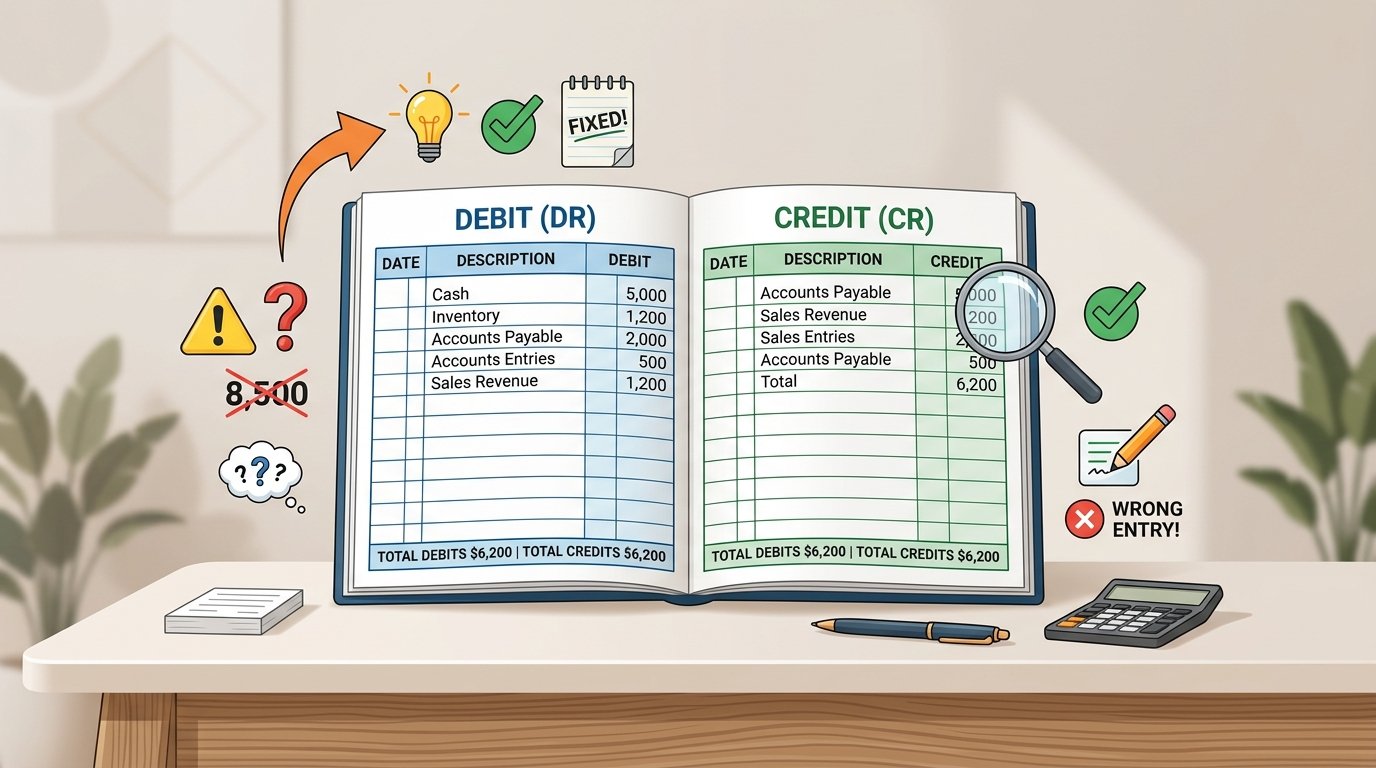
Understanding Debit and Credit Fundamentals
Debits and credits are the backbone of accounting. Debits always go on the left side of an account, and credits go on the right side.
Every transaction affects at least two accounts. The total debits must equal total credits to keep the books balanced.
Key Differences Between Debit and Credit
A debit entry goes on the left side of an account. A credit entry goes on the right side.
Debits and credits do not always mean increase or decrease. Their effect depends on the account type.
Accounts increased by debits:
- Assets (Cash, Accounts Receivable, Equipment)
- Expenses (Rent Expense, Salaries Expense)
- Losses
- Dividends or Drawings
Accounts increased by credits:
- Liabilities (Accounts Payable, Notes Payable)
- Owner’s Equity or Stockholders’ Equity
- Revenues (Sales, Service Revenue)
- Gains
To decrease an account, do the opposite of what increases it. For example, asset accounts grow with debits, so credits decrease them.
Liability accounts grow with credits, so debits decrease them.
When cash comes in, you debit the Cash account. When cash goes out, you credit the Cash account.
This simple rule helps track money movement accurately.
Double-Entry Bookkeeping Explained
Double-entry bookkeeping links every transaction to at least two accounts. One account gets a debit, and another gets a credit for the same amount.
This system keeps the accounting equation balanced: Assets = Liabilities + Equity.
If a company borrows $5,000 from a bank, it debits Cash for $5,000 and credits Notes Payable for $5,000.
If a business pays $800 for rent, it debits Rent Expense for $800 and credits Cash for $800.
Some transactions affect more than two accounts. For example, a loan payment of $300 might debit Notes Payable for $275 and Interest Expense for $25, and credit Cash for $300.
The debits and credits still add up to the same amount.
Common Accounting Misconceptions
Many people think debits always mean decrease and credits always mean increase. This idea causes errors because the account type determines the effect.
Bank statements can confuse beginners. When a bank credits your account, your balance goes up because your deposit is a liability for the bank.
Some bookkeepers incorrectly credit expenses when they occur. Expenses almost always get debited when incurred.
Credits only reduce expenses during adjustments or year-end closing.
Permanent accounts (assets, liabilities, equity) carry balances forward. Temporary accounts (revenues, expenses, dividends) get zeroed out at year end.
Mixing up these account types leads to mistakes in financial statements.
Frequent Credit Card Usage Pitfalls
Many cardholders make mistakes with their credit cards that lower their credit scores and cost them money in interest and fees.
Understanding balances, payments, and credit limits helps avoid these problems.
Carrying a Balance vs. Paying in Full
Carrying a balance from month to month costs money through interest charges. If you do not pay your full statement balance by the due date, interest starts accruing daily at the card’s APR.
The average APR for new credit card offers in 2026 is 22.11%.
Paying only part of the balance causes more problems. You lose your grace period on new purchases, so interest starts on those purchases immediately.
This can make your debt grow faster than you expect.
Paying the full statement balance each month by the due date keeps interest charges at zero. It also maintains your grace period.
If you cannot pay in full, make a plan to pay off the debt as quickly as possible.
Minimum Payments and Their Risks
Minimum payments seem easy but can cause long-term problems. Most of the payment covers interest, not the actual debt.
If you only make minimum payments on a $5,000 balance at 22% APR, you could take over 20 years to pay off the debt and spend thousands in interest.
Credit card companies set minimum payments low, usually 1-3% of the balance. This keeps your account in good standing but stretches out repayment.
Missing even the minimum payment adds late fees and can hurt your credit score if over 30 days late.
Paying more than the minimum reduces the debt faster and saves money on interest. Even an extra $25 or $50 each month makes a difference.
Maxing Out Available Credit
Using too much of your available credit hurts your credit score through the credit utilization rate. This rate compares your current balance to your total credit limit.
Credit scores usually drop if you use more than 30% of your available credit.
The utilization rate affects your score for each card and for all cards combined.
If you have a $10,000 credit limit, keep balances below $3,000 to maintain healthy utilization.
Maxing out cards signals financial stress to lenders and can lower your score.
Credit card companies report balances to credit bureaus once a month when the billing period ends. You can spend more during the month and still protect your score by paying down balances before the statement closes.
This strategy keeps your reported utilization rate low.
Payment Timing Errors and Their Consequences
Payment history is the most important factor in credit scores. Even one payment that’s 30 days late can cause serious damage.
Late fees add up quickly, and the effects on credit reports can last for years.
Not Paying Bills on Time
A missed payment becomes a bigger problem if it reaches 30 days past due. At that point, creditors report the late payment to credit bureaus.
This negative mark stays on your credit report for seven years.
The impact on your credit score is immediate and large. Payment history makes up the biggest part of your score.
A single late payment can drop your score by 90 to 110 points.
Most credit cards charge $25 to $40 for a first late payment. More late payments within six months often lead to higher fees.
Interest rates may also increase to penalty APRs, which can reach 29.99% or more.
You can check your credit reports for free at AnnualCreditReport.com. Regular checks help you spot errors and track your payment history.
Autopay: Benefits and Drawbacks
Autopay helps you avoid missing payment due dates. Banks and creditors let you schedule automatic payments for minimum amounts, set amounts, or full balances.
Benefits of autopay:
- Guarantees on-time payments
- Prevents late fees
- Protects credit scores
- Reduces the stress of tracking due dates
Potential drawbacks:
- May overdraw your account if you do not have enough funds
- Can hide overspending habits
- Needs regular checks to catch billing errors
- May fail because of technical issues or expired payment methods
Keep enough money in your account before autopay dates. Review your statements regularly, even with autopay, to spot unauthorized charges or mistakes.
Missed and Late Payments
Payments under 30 days late usually add fees but do not show up on credit reports. Payments 30, 60, or 90 days late get worse marks on your credit report.
Creditors may give a grace period of 10 to 15 days after the due date before charging late fees. Interest often starts as soon as the due date passes.
Some lenders offer one-time forgiveness for customers with good histories.
If you know you will miss a payment, contact the creditor right away. Many companies offer hardship programs or payment plans.
Set up payment reminders with calendar apps or banking alerts to avoid missing payments in the future.
Mismanaging Credit Accounts
Poor credit account management can lower your credit score and cost you money in fees and interest.
The main mistakes include closing accounts without knowing the impact, opening too many cards too quickly, and taking on credit you do not need.
Closing Credit Cards Incorrectly
Closing a credit card account can hurt your credit score. When you close a card, you lose that credit limit.
This raises your credit utilization rate on your remaining cards.
For example, if you had $10,000 in credit and close a card with a $3,000 limit, you now have $7,000 available. If you have $2,000 in debt, your utilization jumps from 20% to almost 29%.
You might want to close cards with annual fees if you do not use the rewards. You might also close cards that encourage overspending.
Closing your oldest card removes years of credit history that helped your score.
Keep cards active by using them for small purchases every few months. Set up autopay for a recurring bill, then pay it off right away.
Applying for Multiple Cards Too Quickly
Each credit card application creates a hard inquiry on your credit report.
Unlike mortgage or auto loan shopping, credit card inquiries do not get grouped. Each one lowers your score by a few points.
Applying for several cards in a month can lower your score by 15 to 30 points. Lenders may see this as risky behavior.
Space out credit card applications by at least six months. This gives your score time to recover.
Research cards before applying to find the best fit.
Balance transfer cards can help with debt, but opening too many creates the same problem. Pick one card with the best terms.
Unnecessary Credit and Cash Advances
Use credit for a clear financial reason. A personal loan for home repairs or a student loan for education makes sense.
Using a cash advance for a vacation or shopping creates hard-to-justify debt.
Cash advances are expensive mistakes. They usually charge a 3% to 5% fee upfront, plus interest rates of 25% or more that start right away.
There is no grace period for cash advances.
Foreign transaction fees add 1% to 3% to every purchase made abroad or in foreign currency. If you travel often, these fees add up.
Get a card with no foreign transaction fees if you travel.
Credit repair services that promise quick fixes often push unnecessary new accounts. Building credit takes time through on-time payments and low balances, not by opening accounts you do not need.
Overlooking Credit Reports and Key Fees
Many people miss details that affect their financial health. Checking credit reports regularly and understanding all fees helps prevent costly mistakes.
Ignoring Annual Credit Reports
Everyone gets three free credit reports each year through annualcreditreport.com. The three major credit bureaus—Equifax, Experian, and TransUnion—provide these reports.
Many people never check their credit reports and miss errors that can hurt their credit score. Credit reports show payment history, account balances, and personal information.
Errors on these reports happen more often than people realize. Studies show that one in five people has a mistake on at least one report.
Review all three reports because each may contain different information. Requesting one report every four months helps monitor credit year-round.
Set calendar reminders to make checking reports a regular habit.
Understanding Fees and APR
Credit cards charge several fees that add up quickly. The annual fee is a yearly cost for having the card, ranging from $0 to $500 or more.
Foreign transaction fees usually cost 1-3% of each purchase made outside the country. APR (Annual Percentage Rate) determines how much interest you pay on unpaid balances.
Cards often have different APRs for purchases, balance transfers, and cash advances. In 2026, the average credit card APR is about 20-24%.
Late fees can reach $30-$40 for each missed payment. These fees can also trigger penalty APRs, raising interest rates above 29%.
Read the card agreement to understand all these costs before they become problems.
Dealing With Errors on Your Report
Mistakes on credit reports need quick attention. Common errors include accounts that don’t belong to you, incorrect payment statuses, and wrong personal information.
Dispute errors with both the credit bureau and the company that gave the information. Include copies of documents that prove the error.
Credit bureaus have 30 days to investigate disputes. Keep records of all disputes, including letters, emails, and supporting documents.
If the credit bureau doesn’t fix a legitimate error, file a complaint with the Consumer Financial Protection Bureau.
Budgeting and Overspending Mistakes
Poor budgeting habits can lead to overspending, credit card debt, and financial stress. Learning to manage spending limits, build financial safety nets, and prioritize saving helps prevent these mistakes.
Spending Beyond Your Means
Spending more than you earn is a common financial mistake. This often happens when you don’t track expenses or lack a clear budget.
Without knowing where your money goes, it’s easy to overspend on dining out, entertainment, or unnecessary purchases. Relying too much on credit cards to cover expenses you can’t afford with your income creates a cycle of debt.
Unpaid credit card balances accumulate interest charges, making purchases cost more than their original price. To avoid this, track every purchase for at least one month.
This reveals where your money goes and helps spot spending patterns. Create a realistic budget based on actual income to keep expenses within your limits.
Using cash or debit cards for daily purchases can help limit spending to available funds.
Lack of Emergency Fund
An emergency fund provides a cushion for unexpected expenses like medical bills, car repairs, or job loss. Financial experts recommend saving at least six months’ worth of expenses in a dedicated account.
Without an emergency fund, people often turn to credit cards during emergencies, leading to debt. Start building an emergency fund with automatic deductions of $25 or $50 per month.
Keep this money in a separate savings account to avoid using it for non-emergencies. When unexpected costs arise and there is no emergency fund, budgets can fall apart quickly.
If you use your emergency savings, create a plan to replenish it as soon as possible.
Budgeting for Savings
Saving only what’s left over at the end of the month rarely works because there’s usually nothing left to save. Treat saving like a required expense to make sure it happens.
Pay yourself first by setting aside money for savings as soon as you get paid, before paying other bills. Automatic transfers from checking to savings accounts help remove the temptation to spend that money.
Trying to save for too many goals at once spreads money too thin and slows progress. Focus on one or two priorities at a time, such as building an emergency fund before saving for a vacation.
Adjust savings goals when expenses change. During periods of high costs or inflation, it may be necessary to reduce savings amounts, but continue to save something each month.
Building and Repairing Credit Effectively
Building credit takes time and consistent on-time payments. Credit repair requires fixing errors and developing better financial habits.
You can rebuild your credit history with specific strategies and by avoiding scams that promise quick fixes.
Strategies to Build Credit
Pay bills on time to build credit. Make sure every payment reaches the creditor by the due date to avoid negative marks on your credit report.
Secured credit cards help people who don’t qualify for regular cards. You put down a deposit equal to your credit limit, and as you make on-time payments, many banks increase your limit and refund the deposit.
These cards help establish a credit history when used responsibly. Keep your credit utilization low—experts recommend staying below 30% of your total limit, though under 10% is even better.
Paying off the full balance each month prevents interest charges and keeps utilization low. Avoid applying for multiple credit accounts in a short period, as each application can temporarily lower your score.
Keep accounts open and active for years to show lenders a longer track record of responsible borrowing.
Activities that don’t build credit include:
- Using debit cards or cash
- Loading money onto prepaid cards
- Taking payday loans
- Financing through car lots that don’t report payments
Avoiding Common Credit Repair Scams
Credit repair takes time. Companies that promise to remove accurate negative information or boost scores by hundreds of points quickly are running scams.
Dispute errors on your credit reports for free at annualcreditreport.com. Check all three reports from Equifax, Experian, and TransUnion every year.
Equifax offers six additional free reports through December 31, 2026. When you find an error, file a dispute directly with the credit reporting company and the business that provided the incorrect information.
This process is free and doesn’t require a third party. Most negative information stays on reports for seven years, and Chapter 7 bankruptcy remains for 10 years.
Recent negative marks affect scores more than older ones. No service can legally remove accurate information before these timeframes end.
Using Best Rewards Credit Cards Wisely
Rewards credit cards offer cash back, points, or travel benefits. These cards work best for people who pay their full balance every month and already have good credit habits.
Carrying a balance reduces the value of rewards. Interest charges on unpaid balances usually cost more than any rewards earned.
For example, if you spend $1,000 and earn 2% cash back, you get $20. But paying 18% interest on that balance costs $180 a year.
Wait until you have consistent on-time payment habits before applying for rewards cards. Opening too many accounts at once can hurt your credit score and make payments harder to manage.
Treat rewards cards like debit cards. Only charge what you can pay off immediately, and set up automatic payments to avoid missing due dates.
This approach builds credit history and earns rewards without debt.
Frequently Asked Questions
Many people make the same mistakes with debits and credits because accounting words work differently than in everyday language. Understanding how account types behave helps prevent errors.
What are the most common debit and credit errors people make when recording transactions?
The biggest mistake is thinking debit always means increase and credit always means decrease. These words have different meanings in banking and accounting.
Recording only one side of a transaction is another common error. Every transaction needs both a debit and a credit entry to show what changed.
People often confuse assets with expenses. Buying a computer creates an asset because the business owns something useful. Paying rent creates an expense because the benefit is consumed that month.
Mixing up revenue with cash received causes problems. A business earns revenue when work is completed, not always when payment arrives.
Customer deposits are liabilities until the work is done.
How can you tell whether an account should be debited or credited in a given entry?
First, identify what type of account changed. Assets, expenses, liabilities, equity, and revenue each follow different rules.
Next, decide whether the account increased or decreased. A debit increases assets and expenses but decreases liabilities, equity, and revenue.
A credit does the opposite. Use a four-step method: identify the accounts affected, decide if each increased or decreased, determine the account type, then apply the rules.
Ask practical questions to avoid confusion. Did the business receive something it still owns? That suggests an asset. Did it consume something to operate? That suggests an expense.
What are the basic rules that govern debits and credits across assets, liabilities, equity, revenue, and expenses?
Assets increase with debits and decrease with credits. When a business receives cash or buys equipment, the asset account gets debited.
Expenses increase with debits and decrease with credits. Rent, salaries, and utilities all increase with debit entries.
Liabilities increase with credits and decrease with debits. Taking out a loan credits the liability account. Paying it back debits the liability account.
Equity increases with credits and decreases with debits. Owner investments credit equity. Owner withdrawals debit equity.
Revenue increases with credits and decreases with debits. Sales and service income credit the revenue account when earned.
How do reversed debits and credits affect financial statements and account balances?
Reversing debits and credits creates incorrect balances. If you credit cash when you should debit it, the cash balance shows less money than actually exists.
Wrong entries make financial statements unreliable. An overstated expense account makes profit look lower than it is.
An understated revenue account makes sales look weaker than they are. Asset accounts with reversed entries show incorrect values, which affects the balance sheet.
Liability accounts with errors show wrong amounts owed. The business might think it has less debt than it actually carries or miss tracking what it owes.
What practical steps can prevent debit and credit mistakes when using accounting software or spreadsheets?
Use account templates in software to reduce errors. Most accounting programs have preset account types that apply correct debit and credit behavior.
Create a simple checklist to prevent mistakes. Before saving any entry, verify both accounts are identified, amounts match on both sides, and the entry makes sense.
Reconcile accounts regularly to catch errors early. Compare bank statements to accounting records to check if cash entries are correct.
Set up validation rules in spreadsheets for extra protection. Formulas can check that debits equal credits before allowing an entry to save.
Use the DEALER memory tool: Dividends, Expenses, and Assets increase with Debits. Liabilities, Equity, and Revenue increase with credits.
How do lenders use a credit report when evaluating a loan application?
Lenders review credit reports to see how borrowers have managed debt in the past. Payment history shows if someone pays bills on time or misses deadlines.
Credit scores sum up the information in a credit report. Higher scores mean lower risk and can lead to better interest rates.
The report lists total debt and available credit. Lenders use this information to calculate debt-to-income ratios.
Negative marks like late payments, collections, or bankruptcies signal higher risk. These issues may lead to loan denials or higher rates.
Lenders check current employment and income. Credit reports show the debt picture, while income verification confirms the ability to make future payments.
Leave a Reply