
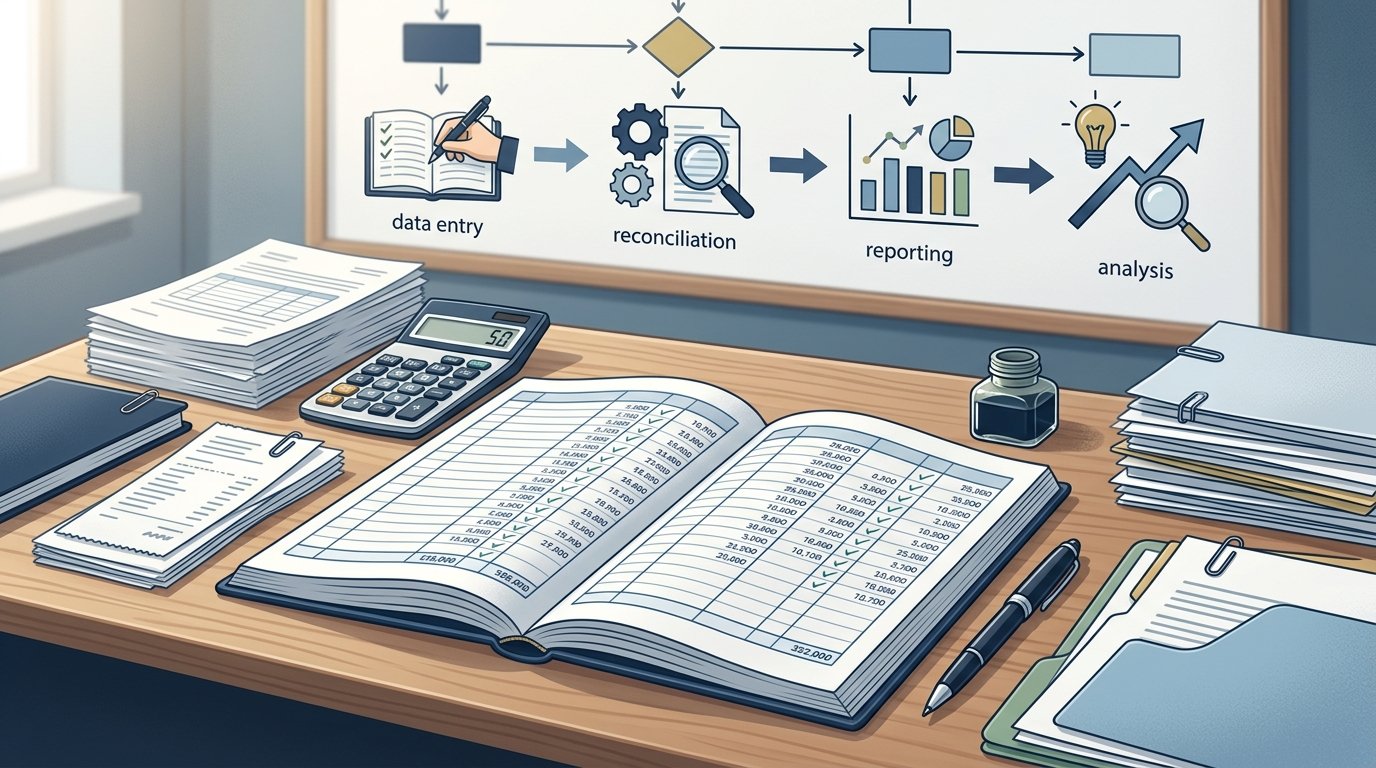
Core Bookkeeping Principles
Every business uses specific rules to keep financial data accurate and balanced. Double-entry bookkeeping requires each transaction to affect at least two accounts.
Journals and ledgers organize this information from the initial recording to final account balances.
Understanding Double-Entry Bookkeeping
Double-entry bookkeeping forms the foundation of modern accounting. Each transaction must affect at least two accounts.
When a business records a transaction, the total debits must equal the total credits. This system checks for errors by requiring balanced records.
A debit appears on the left side of an account, and a credit appears on the right side. Each transaction has two sides.
For example, if a company buys supplies with cash, it debits Supplies and credits Cash for the same amount.
This method helps prevent errors because accounts must stay balanced. If debits and credits do not match, something is wrong.
Accounting software enforces this rule by rejecting unbalanced entries.
Role of Journals and Ledgers
Journals are the first place businesses record transactions. Each entry includes the date, accounts affected, amounts, and a brief description.
Businesses often keep separate journals for sales, purchases, cash receipts, and cash payments.
Ledgers organize all transactions by account type. After recording entries in journals, bookkeepers post these amounts to accounts in the general ledger.
Each account in the ledger shows all related transactions and a running balance.
Modern accounting software records the journal entry and updates the ledger accounts at the same time. The software keeps detailed records for each account and organizes everything for financial statement preparation.
Debits, Credits, and the Chart of Accounts
The chart of accounts lists every account a business uses. It organizes accounts into assets, liabilities, equity, revenue, and expenses.
Each account gets a unique number or code for easy reference.
Debits increase asset and expense accounts but decrease liability, equity, and revenue accounts. Credits do the opposite: they increase liabilities, equity, and revenue, and decrease assets and expenses.
These rules guide how bookkeepers record each transaction.
Account Type Rules:
| Account Type | Increased By | Decreased By |
|---|---|---|
| Assets | Debit | Credit |
| Expenses | Debit | Credit |
| Liabilities | Credit | Debit |
| Equity | Credit | Debit |
| Revenue | Credit | Debit |
Account balances reflect the difference between total debits and credits for each account. A well-organized chart of accounts makes it easier to find transactions, generate reports, and keep accurate records.
Transaction Recording and Documentation
Every transaction needs a clear record and a proper entry in the accounting system. Organized books depend on capturing source documents, entering receipts and invoices, and recording money in and out.
Collecting and Organizing Source Documents
Source documents prove that a transaction happened. These include receipts, invoices, bank statements, credit card statements, and vendor bills.
A business should collect these documents as soon as transactions occur. Delays can lead to lost receipts or forgotten details.
Most accounting software allows users to photograph receipts with a mobile app and attach them to transactions.
Organize source documents by month and transaction type. Keep separate folders for customer invoices, vendor bills, bank statements, and expense receipts.
Digital storage saves space and makes documents easy to search. Some paper records must be kept for legal reasons.
Without proper source documents, a business cannot prove its expenses during an audit. Tax authorities require documentation for every deduction claimed.
Accurate Entry of Receipts and Invoices
Enter receipts and invoices into the accounting system with all details. For receipts, record the vendor name, date, amount, and expense category.
For invoices, enter the customer name, invoice number, date, amount, and payment terms.
Match each receipt to the correct expense account in the chart of accounts. For example, restaurant meals go to meals and entertainment, office supplies to supplies, and software subscriptions to software expenses.
Consistent categorization prevents confusion during month-end reporting.
When a business sends an invoice to a customer, it creates an accounts receivable entry showing money owed. When the business receives an invoice from a vendor, it creates an accounts payable entry showing money the business owes.
Track both separately to manage cash flow.
Enter invoices as soon as work is completed to speed up payment collection. Enter bills when they arrive to avoid late fees.
Recording Expenses and Revenues
Expenses and revenues are the basis of profit and loss reporting. Every dollar spent is an expense, and every dollar earned is revenue.
Record each expense with the amount, category, date, and reason for the purchase. For example, $500 for advertising, $200 for rent, or $75 for utilities.
When a customer pays for a product or service, record the amount, customer name, date, and what was sold as revenue. This information helps track accounts receivable and identify top customers.
Cash basis businesses record revenue when money arrives and expenses when money leaves. Accrual basis businesses record revenue when earned and expenses when incurred, even if cash has not moved.
Use the same method throughout the year.
Managing Accounts and Period-End Procedures
Period-end procedures keep financial records accurate before closing the books. These tasks include matching bank statements to transactions, processing payroll and prepaid costs, and recording events that occurred but have not been paid yet.
Reconciling Accounts and Bank Statements
Bank reconciliation compares the company’s cash records to the bank statement to find differences. This process catches errors, missing transactions, and unauthorized charges.
Start with the ending balance from the bank statement. Add deposits recorded in the books but not yet on the bank statement, and subtract outstanding checks not yet cleared.
Common differences include bank fees, interest earned, and bounced checks. These items appear on the bank statement but not yet in the company’s records.
Make adjusting entries to record these transactions.
Key reconciliation steps:
- Compare deposits in the books to deposits on the bank statement
- Match cleared checks to recorded payments
- Investigate any discrepancies
- Record bank fees, interest, and other bank-initiated transactions
- Verify the adjusted balances match
Reconciliation strengthens internal controls by involving multiple people in reviewing cash transactions. Most businesses reconcile accounts monthly, but some do it weekly or daily.
Payroll and Prepaid Expenses Management
Payroll includes gross wages, tax withholdings, and employer contributions for benefits and payroll taxes. Companies track these amounts separately to report and pay employees and tax authorities correctly.
Record payroll by entering wages earned, taxes and benefits withheld, and the net amount paid to employees. Record employer-paid taxes and benefits as separate expenses.
Prepaid expenses are payments for goods or services used in future periods. Examples include insurance premiums, rent paid in advance, and annual software subscriptions.
Record these as assets when paid, then move them to expense accounts as used.
Monthly prepaid expense adjustment:
- Calculate the portion used during the month
- Move that amount from the asset account to the expense account
- Update the prepaid asset balance
Handling Accruals and Adjusting Entries
Accrual accounting records revenue when earned and expenses when incurred, not when cash changes hands. This requires adjusting entries at period-end.
Accruals record expenses or revenue that have occurred but have not yet been paid or received. Examples include wages earned but not yet paid, utilities used but not yet billed, and interest on loans.
Adjusting entries also handle depreciation, which spreads the cost of long-term assets over their useful lives. For example, a building purchased for $300,000 with a 30-year life gets $10,000 in depreciation expense each year.
Types of adjusting entries:
- Accrued expenses – costs incurred but not yet paid
- Accrued revenue – income earned but not yet received
- Deferred expenses – prepaid items moved to expense
- Deferred revenue – advance payments moved to income
- Depreciation – spreading asset costs over time
These adjustments make sure financial statements reflect the business’s true financial position at period-end.
Trial Balances and Correction of Errors
A trial balance checks that total debits equal total credits in the accounting system. This report serves as a checkpoint for accuracy.
Preparing a Trial Balance
A trial balance lists all general ledger accounts with their ending debit or credit balances at a specific time. Bookkeepers prepare this report before adjustments, after adjustments, and after closing entries.
To prepare a trial balance, extract the balance from each account in the general ledger. Debit balances go in the left column, credit balances in the right.
Total both columns to verify they match.
Accounting software can generate trial balances and check that debits equal credits. Manual systems require careful addition and double-checking.
The report helps find posting errors before preparing financial statements.
A balanced trial balance does not guarantee error-free records. It only confirms that debits and credits match.
Identifying and Correcting Discrepancies
If a trial balance does not balance, the difference can reveal the error type. A difference divisible by 9 often means numbers were transposed, such as recording 54 instead of 45.
Common errors include:
- One-sided entries where only a debit or credit was recorded
- Incorrect additions in account balances or totals
- Transposed numbers in amounts from journals
- Reversed entries where debits and credits were switched
Some errors do not affect the trial balance. For example, entries made twice, entries to the wrong account, and omitted transactions.
Bookkeepers find these through account reconciliations and detailed review.
Bookkeepers correct errors with clearly labeled journal entries and supporting documentation. Each correction reverses the incorrect entry and records the proper amounts.
A suspense account can temporarily hold unexplained differences until the problem is found and fixed.
Closing Procedures and Period-End Activities
Closing the books means transferring balances from temporary accounts to permanent ones. This process finalizes all financial records for the period.
It ensures that each accounting period starts fresh and that financial statements show the organization’s performance accurately.
Posting Closing Entries
At the end of an accounting period, accountants make closing entries to reset temporary account balances to zero. These entries move the balances to permanent accounts so they carry forward.
The process follows a set order. Accountants close revenue accounts first by debiting each revenue account and crediting an income summary account.
Next, they close expense accounts by crediting each expense account and debiting the income summary. The income summary account then shows the net income or net loss for the period.
In the final step, accountants close the income summary to retained earnings. If the company earned a profit, they debit the income summary and credit retained earnings.
A loss requires the opposite entry. Accountants also close dividends or owner withdrawals directly to retained earnings or capital accounts.
Accountants post all closing entries to the general ledger before finalizing financial statements. This ensures the records are ready for the next period.
Temporary and Permanent Accounts
Temporary accounts record financial activity for a single accounting period. These include all revenue accounts, expense accounts, and dividend or withdrawal accounts.
Their balances reset to zero at the end of each period through closing entries. Permanent accounts keep ongoing balances that carry forward from one period to the next.
Assets, liabilities, and equity accounts are permanent. The ending balance of one period becomes the beginning balance of the next.
If an accountant fails to close a revenue account, that revenue would incorrectly appear in the next period’s records.
| Account Type | Examples | Closes at Period-End? |
|---|---|---|
| Temporary | Revenue, expenses, dividends | Yes |
| Permanent | Cash, accounts payable, retained earnings | No |
Month-End Close and Year-End Review
The month-end close finalizes all accounting activities for the month. Accountants reconcile bank statements, verify account balances, record accruals for unpaid expenses, and post depreciation entries.
Accountants must record all transactions in the correct period based on when they occurred. Most finance teams finish the month-end close within three to ten days.
Faster closes give decision-makers timely data for planning and analysis. Automation tools help speed up reconciliations and reduce manual work.
The year-end close uses the same steps as month-end but adds more requirements. Accountants prepare annual financial statements, calculate tax liabilities, and ensure compliance with regulatory reporting standards.
They update fixed asset schedules for depreciation and disposals. Accountants verify and reconcile inventory counts to the general ledger.
Year-end closing also clears all temporary accounts for the new fiscal year. This separates each year and ensures accurate comparative reporting.
Preparation and Presentation of Financial Statements
Financial statements turn bookkeeping data into structured reports that show a company’s financial position and performance. These documents follow accounting standards and include the income statement, balance sheet, and cash flow statement.
Income Statement and Balance Sheet Fundamentals
The income statement shows a company’s revenues and expenses over a period. It starts with total revenue, then subtracts the cost of goods sold to get gross profit.
Operating expenses come next, followed by other income or expenses, to reach net income. The balance sheet lists what a company owns and owes at a specific date.
It uses the equation: Assets = Liabilities + Equity. Assets include cash, accounts receivable, inventory, and property.
Liabilities and equity include accounts payable, loans, and owner’s capital. These appear on the opposite side or section from assets.
Key Balance Sheet Components:
- Current Assets: Cash, receivables, inventory
- Fixed Assets: Property, equipment, vehicles
- Current Liabilities: Accounts payable, short-term debt
- Long-term Liabilities: Mortgages, bonds payable
- Equity: Owner’s capital, retained earnings
GAAP sets specific formatting and classification rules for both statements. Each line item must appear in the correct section with clear labels.
Cash Flow Statement and Financial Analysis
The cash flow statement tracks cash movement through three categories: operating activities, investing activities, and financing activities.
Operating activities show cash from daily business operations. Investing activities cover purchases or sales of long-term assets.
Financing activities include loans, equity investments, and dividend payments. Financial analysis uses these statements to calculate ratios and trends.
The current ratio divides current assets by current liabilities to measure short-term financial health. Profit margins compare net income to revenue.
Debt-to-equity ratios assess financial leverage. Bookkeepers prepare financial statements by pulling data from adjusted trial balances.
Each account balance moves to its proper statement. Revenue and expense accounts go to the income statement.
Asset, liability, and equity accounts go on the balance sheet.
Compiling Professional Financial Reports
Professional financial reports combine all three main statements with supporting notes and disclosures. The notes explain accounting policies, detail specific line items, and disclose important information not shown in the numbers.
Bookkeepers start the compilation process by completing all adjusting entries. They verify account balances match source documents.
Bookkeepers check that debits equal credits and that all transactions post to the correct period.
Financial Statement Preparation Steps:
- Complete all adjusting journal entries
- Generate an adjusted trial balance
- Prepare the income statement first
- Transfer net income to the balance sheet
- Create the cash flow statement
- Add notes and disclosures
- Review for accuracy and compliance
Financial reporting standards require consistent presentation from period to period. The format helps users compare current results with prior years.
Headers show the company name, statement title, and the period or date covered.
Bookkeeping Tools, Software, and Career Development
Modern bookkeepers use specialized software to manage financial records efficiently. Continuous learning and best practices support long-term career success.
The right mix of tools, systematic approaches, and professional development builds a strong foundation for growth in this stable profession.
Selecting and Using Accounting Software
Bookkeeping software is essential for managing financial records in 2026. QuickBooks and Xero are leading platforms that handle invoicing, payroll, and financial reporting automatically.
QuickBooks offers versions for small businesses and larger organizations. It tracks income and expenses, generates reports, and connects to bank accounts for real-time updates.
Xero provides cloud-based solutions with strong inventory management features. Multiple users can access financial data at the same time, which suits businesses with accounting departments.
When choosing accounting software, businesses should consider their needs. Key factors include transaction volume, needed integrations, and remote access.
Most platforms offer free trials so users can test features before buying. Spreadsheets remain useful for basic record-keeping and custom calculations.
However, dedicated bookkeeping software reduces errors and saves time through automation.
Best Practices for Bookkeepers and Accountants
Daily accuracy prevents problems during tax season and financial audits. Bookkeepers should reconcile bank statements weekly, not just at month-end.
A consistent filing system for receipts and invoices saves time. Digital storage with clear naming works better than physical files for most businesses.
Essential daily tasks include:
- Recording all transactions on the day they occur
- Categorizing expenses correctly
- Backing up financial data to secure cloud storage
- Reviewing accounts receivable and payable
Good communication with accountants improves financial outcomes. Bookkeepers should flag unusual transactions right away and keep records organized for easy review.
Regular check-ins help prevent misunderstandings about transaction classification. Separating duties protects against fraud.
When possible, assign different people to handle deposits, payments, and reconciliation.
Training, Courses, and Professional Growth
No degree is required to start a bookkeeping career in 2026. Many people enter the field through on-the-job training and self-study.
Bookkeeping courses cover:
- Double-entry accounting principles
- Tax compliance and reporting
- Software training for QuickBooks or Xero
- Payroll processing and regulations
Online platforms offer flexible learning for working professionals. Courses range from beginner topics to advanced subjects like financial analysis and forecasting.
Professional certifications increase credibility and earning potential. The Certified Bookkeeper designation shows mastery of core skills to employers and clients.
Some positions require these credentials. On-the-job training gives practical experience with company-specific processes.
New bookkeepers learn internal systems, industry requirements, and how their organization handles unique transactions. Career advancement can lead to roles in accounting departments or specialized areas like taxation and financial planning.
Continuous learning through workshops, webinars, and industry publications keeps skills current as regulations and software change. Building expertise in industries like healthcare or construction can lead to higher-paying jobs.
Frequently Asked Questions
Bookkeeping uses a structured process with clear stages, daily practices, and skill requirements that beginners need to learn. The journey from entry-level work to professional competence requires understanding process flows, routine management, core skills, entry strategies, training resources, and resume presentation.
What are the five stages of the bookkeeping process, and what does each stage involve?
The bookkeeping process has five stages that turn raw financial data into organized records. Each stage builds on the last to create a full financial picture.
First, bookkeepers identify and collect source documents like receipts, invoices, bank statements, and payment records. Every financial transaction needs supporting documentation.
Second, bookkeepers record these transactions in journals. They create journal entries that show debits and credits for each transaction.
Posting to the ledger is the third stage. Bookkeepers transfer journal entries to individual account ledgers in the chart of accounts.
This organizes transactions by category such as cash, accounts receivable, or expenses. The fourth stage is preparing a trial balance.
This report lists all account balances to check that total debits equal total credits. Errors show up when the accounts don’t balance.
The fifth stage creates financial statements. The trial balance data generates income statements, balance sheets, and cash flow statements.
How can I set up a daily bookkeeping routine to keep transactions accurate and up to date?
A daily bookkeeping routine prevents backlog and keeps records accurate. Good habits reduce errors and save time during month-end closing.
Start each day by reviewing and recording all new transactions. Process receipts, invoices, and bank activity from the previous business day.
This keeps documents from piling up or getting lost. Reconcile cash and card transactions daily.
Compare point-of-sale records to actual deposits and payments. Small discrepancies are easier to find and fix right away.
Update accounts receivable and payable. Record customer payments and mark invoices as paid.
Enter new bills and schedule payment dates. Set aside 15 to 30 minutes at the same time each day for these tasks.
Morning sessions work well for reviewing the previous day’s activity. A consistent schedule builds the habit and ensures nothing is missed.
If using accounting software, review bank and credit card feeds. Categorize transactions and match them to existing entries.
This keeps the books in sync with actual bank activity.
What core bookkeeping skills should I master before advancing to higher-level accounting tasks?
Core bookkeeping skills form the base for all accounting work. Mastering these basics ensures accuracy and prepares you for advanced tasks.
Understanding debits and credits is essential. Every transaction affects at least two accounts, and bookkeepers must know which accounts to debit and credit.
Accurate data entry prevents errors from spreading. Bookkeepers need to enter numbers correctly and check their work.
Attention to detail is more important than speed. Bank reconciliation skills help ensure records match reality.
Monthly reconciliation catches errors, finds missing transactions, and detects possible fraud. This process checks that the books reflect actual bank balances.
Knowledge of the chart of accounts helps organize financial data. Bookkeepers must know account types and how to categorize transactions.
Proper categorization makes reports clear and useful. Basic financial statement reading lets bookkeepers check their work.
Understanding how transactions flow to income statements and balance sheets helps catch mistakes. This skill connects bookkeeping and accounting.
Software proficiency is now mandatory. Most businesses use programs like QuickBooks, Xero, or similar platforms.
Bookkeepers need to feel comfortable with digital tools and cloud-based systems.
How can I become a bookkeeper with no experience, and what first steps matter most?
You can start a bookkeeping career without experience by focusing on learning and building key skills. Take several practical steps to open doors to entry-level positions.
Begin by learning basic accounting principles through free online courses. Websites like AccountingCoach offer beginner tutorials on debits, credits, and financial statements.
Study these concepts before moving on to practical tasks. Practice using bookkeeping software with free trials or demo companies.
Try QuickBooks and Xero, which provide practice files for recording transactions safely. This hands-on experience boosts your confidence and helps you become familiar with the software.
Earn a basic certification like the AIPB or NACPB credential to show commitment to employers. These programs teach you the fundamentals and give structure to your self-study.
Volunteer to manage books for a small nonprofit or family business. Real-world practice helps you build skills faster and adds experience to your resume.
Look for part-time or contract work through platforms that connect bookkeepers with small businesses. Remote positions let you gain paid experience while you keep learning.
As you complete projects, build a portfolio to attract better opportunities.
Which online resources offer practical, free bookkeeping training that is still reliable?
Several quality platforms offer free bookkeeping education with practical skills and structured lessons. AccountingCoach provides comprehensive content covering bookkeeping fundamentals.
The site features explanations, quizzes, and visual aids for topics like journal entries and financial statements. You can find over 1,500 questions and answers for specific scenarios.
YouTube channels from accounting professionals show software techniques and real processes. Video tutorials use screen recordings to demonstrate transaction entry and reconciliation.
Software companies like QuickBooks, Xero, and FreshBooks maintain free tutorial libraries for their platforms. These guides teach you how to use software features and workflows.
Public libraries often give free access to learning platforms such as LinkedIn Learning. With a library card, you can take professional bookkeeping courses at no cost.
The Small Business Administration website offers bookkeeping guides, templates, and downloadable tools for business financial management. These government resources are free and reliable.
What bookkeeping skills and tools should I highlight on a resume to match common employer expectations?
Employers seek specific technical skills and software knowledge when they hire bookkeepers.
Showcase both foundational skills and practical tool proficiency on your resume.
List your accounting software experience clearly. Name programs like QuickBooks Desktop, QuickBooks Online, Xero, Sage, or FreshBooks.
Include version numbers and the number of years you have worked with each platform.
Emphasize your bank reconciliation skills. Show that you can match transactions and resolve discrepancies.
Mention your experience with accounts payable and receivable management. These tasks are central to most bookkeeping roles.
Specify your work with invoice processing, payment scheduling, and collections.
Add your financial reporting abilities. State your experience preparing income statements, balance sheets, and cash flow reports.
Leave a Reply