
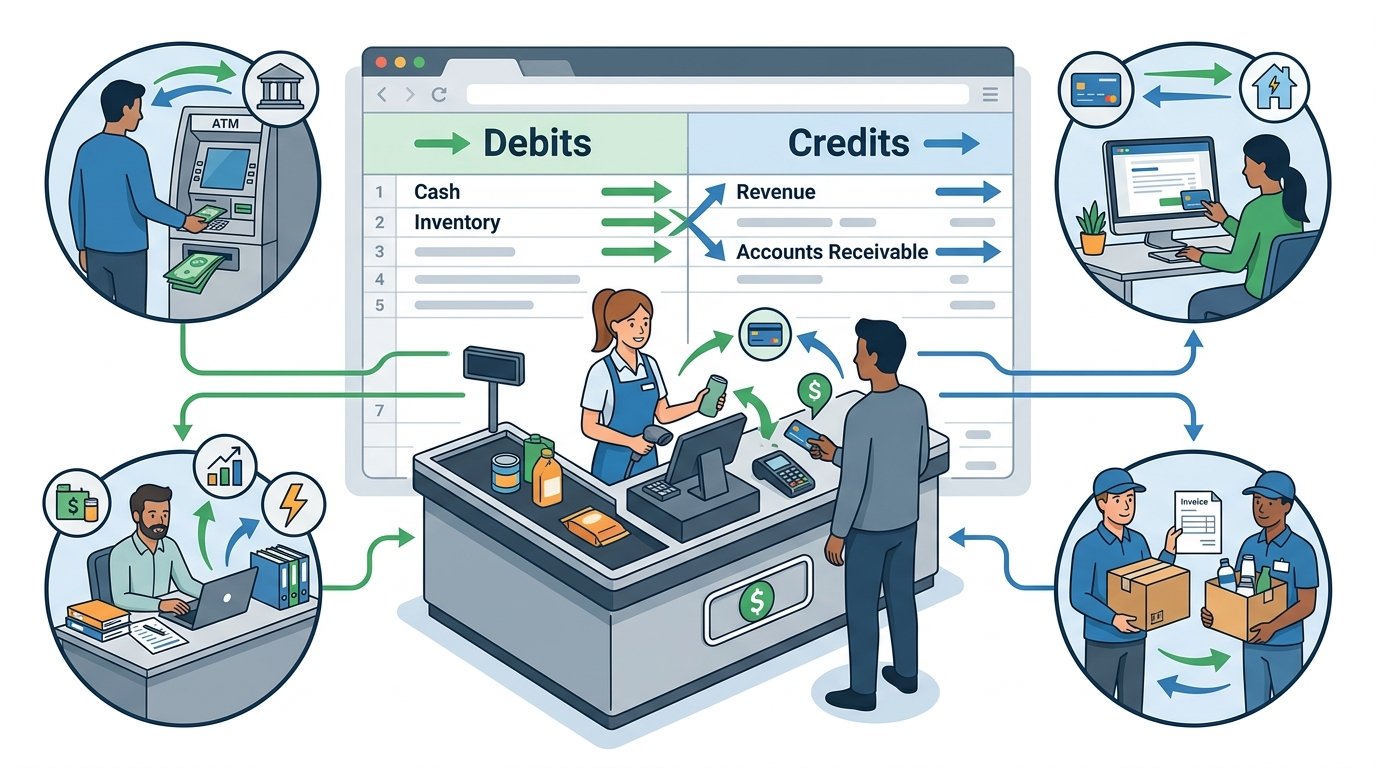
Understanding the Core Principles of Debits and Credits
Accountants use debits and credits together in every transaction to keep financial records accurate. Each debit entry always matches a credit entry of equal value.
What Are Debits and Credits?
Debits and credits are the basic terms for recording financial transactions. A debit records an amount on the left side of an account. A credit records an amount on the right side.
These terms do not always mean “increase” or “decrease.” Their effect depends on the account type. A debit can increase one account but decrease another.
Accountants use “dr.” for debit and “cr.” for credit. Every business transaction changes at least two accounts—one gets debited, the other credited for the same amount.
This balanced method helps accountants track and verify records.
Debit vs Credit: Fundamental Differences
Debits and credits affect accounts differently. Debits increase assets and expenses but decrease liabilities and equity. Credits do the opposite.
You can remember this with the DEAL pattern:
- Dividends
- Expenses
- Assets
- Losses
Debits increase these accounts.
The GIRLS pattern covers accounts that increase with credits:
- Gains
- Income
- Revenues
- Liabilities
- Stockholders’ Equity
When you receive cash, you debit the Cash account. When you pay out cash, you credit the Cash account. This rule helps beginners understand debits and credits.
The Role of Debits and Credits in Double-Entry Accounting
Double-entry accounting means every transaction changes at least two accounts. One account gets a debit, another gets a credit for the same amount.
If a company borrows $5,000 from a bank, it debits Cash for $5,000 and credits Notes Payable for $5,000. Both accounts change by the same amount.
If the company repays $2,000, it credits Cash and debits Notes Payable for $2,000.
Accountants can check accuracy easily because total debits must always equal total credits.
Normal Balances and Accounting Rules
Each account type has a normal balance on either the debit or credit side. Knowing normal balances helps accountants record transactions correctly.
| Account Type | Normal Balance | Increased By | Decreased By |
|---|---|---|---|
| Assets | Debit | Debit | Credit |
| Liabilities | Credit | Credit | Debit |
| Equity | Credit | Credit | Debit |
| Revenue | Credit | Credit | Debit |
| Expenses | Debit | Debit | Credit |
Asset accounts like Cash and Inventory usually have debit balances. Credit increases liabilities such as Accounts Payable and Notes Payable, which usually have credit balances. Revenue accounts also have credit balances.
Expense accounts hold debit balances. Accountants debit expense accounts to increase them and credit them to decrease. These rules apply to all businesses.
Account Types and Their Impact on Everyday Transactions
Each transaction affects specific account categories. Understanding how asset, liability, equity, revenue, and expense accounts respond to different transactions explains why accountants record entries in certain ways.
Asset Accounts and Debit Applications
Asset accounts show what a business owns or controls. These include Cash, Accounts Receivable, Inventory, Equipment, and Prepaid Rent. Debits increase asset accounts, credits decrease them.
If a company receives $1,000 cash from a customer, it debits Cash by $1,000. If it pays $300 for supplies, it credits Cash by $300 and debits Supplies by $300.
When a business provides a $500 service on credit, it debits Accounts Receivable for $500. When the customer pays, the business credits Accounts Receivable for $500 and debits Cash for $500.
Common Asset Account Transactions:
- Receiving cash payments – Debit Cash
- Purchasing equipment – Debit Equipment, Credit Cash
- Collecting customer payments – Debit Cash, Credit Accounts Receivable
- Buying supplies – Debit Supplies, Credit Cash or Accounts Payable
Liability Accounts and Credit Principles
Liability accounts show what a business owes to others. These include Accounts Payable, Notes Payable, Wages Payable, and Loans Payable. Credits increase liabilities, debits decrease them.
If a company borrows $5,000 from a bank, it credits Notes Payable for $5,000 and debits Cash for $5,000. If it repays $2,000, it debits Notes Payable for $2,000 and credits Cash for $2,000.
When a business buys $800 of inventory on credit, it credits Accounts Payable for $800 and debits Inventory for $800. When the business pays the supplier, it debits Accounts Payable for $800 and credits Cash for $800.
The accounting equation (Assets = Liabilities + Equity) stays balanced because each transaction affects at least two accounts.
Equity Accounts in Daily Use
Equity accounts show the owner’s share of the business. Sole proprietors use capital and drawing accounts. Corporations use stockholders’ equity and retained earnings. Credits increase equity accounts, debits decrease them.
When an owner invests $10,000, the capital account gets credited for $10,000 and Cash gets debited for $10,000. If the owner withdraws $500, the drawing account gets debited for $500 and Cash gets credited for $500.
Retained earnings increase when a corporation earns net income. At year-end, revenue accounts close to retained earnings, increasing it. Expense accounts close to retained earnings, decreasing it.
The capital account and retained earnings appear on the balance sheet as part of owner’s equity.
Revenue and Expense Accounts Explained
Revenue accounts track income from business operations. Expense accounts track costs to earn that income. Credits increase revenue accounts. Debits increase expense accounts.
If a business completes a $400 service and receives payment, it debits Cash for $400 and credits Service Revenue for $400. If the service is on credit, it debits Accounts Receivable for $400 and credits Service Revenue for $400.
If a business pays $800 for rent, it debits Rent Expense for $800 and credits Cash for $800. If employees earn $1,900 in wages but haven’t been paid, the business debits Wages Expense for $1,900 and credits Wages Payable for $1,900.
Key Revenue and Expense Account Rules:
| Account Type | Normal Balance | To Increase | To Decrease |
|---|---|---|---|
| Revenue | Credit | Credit | Debit |
| Expense | Debit | Debit | Credit |
Revenue and expense accounts are temporary. Their balances transfer to equity accounts at year-end, resetting them to zero for the new year. The chart of accounts lists all revenue and expense accounts a business uses.
The Framework of Double-Entry Bookkeeping
Double-entry bookkeeping means every transaction changes at least two accounts. One account receives a debit, another receives a credit. This system uses T-accounts and journal entries to track money in the general ledger.
Understanding T-Accounts and T-Account Examples
A T-account is a visual tool that shows both sides of any account. Debits go on the left, credits go on the right. The account name sits at the top.
If a company borrows $5,000, it debits Cash for $5,000 on the left of the T-account. It credits Notes Payable for $5,000 on the right. If the company repays $2,000, it credits Cash for $2,000 and debits Notes Payable for $2,000.
T-accounts help accountants see balances quickly. Asset accounts usually show balances on the left. Liability accounts usually show balances on the right.
The Role of the General Ledger
The general ledger holds all company accounts. Each account keeps a running balance of debits and credits.
The chart of accounts organizes the ledger. It lists balance sheet accounts first: assets, liabilities, and equity. Income statement accounts follow: revenues and expenses.
The general ledger provides the numbers for financial statements. Every debit and credit from journal entries goes to specific accounts in the ledger. All accounts must stay balanced, with total debits always equaling total credits.
Recording Transactions and Journal Entries
Journal entries are the first step in recording transactions. Each entry shows the date, the accounts changed, and the amounts. Accounts receiving debits appear first; credited accounts follow and are indented.
If a company receives $500 from a customer, it debits Cash for $500 and credits Accounts Receivable for $500. If it pays $300 to a supplier, it debits Accounts Payable for $300 and credits Cash for $300.
Every transaction needs at least one debit and one credit. Some need more. For example, a loan payment of $300 might debit both Notes Payable and Interest Expense and credit Cash for the total.
Common Daily Business Transactions: Debit and Credit Examples
Businesses handle similar transactions each day, like recording sales or paying bills. Debits increase assets and expenses, while credits increase liabilities, equity, and revenue.
Sales Revenue and Service Revenue Transactions
When a business makes a sale, it records the transaction based on the payment method. A cash sale debits the cash account and credits sales revenue. The debit increases assets, and the credit increases revenue.
Service businesses record service revenue the same way. If a law firm receives $2,000 for legal services, it debits cash for $2,000 and credits service revenue for $2,000.
Sales on credit use accounts receivable instead of cash. If a store sells $500 of products on credit, it debits accounts receivable for $500 and credits sales revenue for $500.
Journal entry for a cash sale:
- Debit: Cash $1,000
- Credit: Sales Revenue $1,000
Journal entry for a credit sale:
- Debit: Accounts Receivable $1,000
- Credit: Sales Revenue $1,000
Managing Accounts Receivable and Accounts Payable
Accounts receivable tracks money customers owe to the business. When a customer pays their balance, the business debits cash and credits accounts receivable.
This entry moves value from one asset account to another. Total assets do not change.
If a business has $3,000 in outstanding receivables and collects payment, it records a debit to cash for $3,000 and a credit to accounts receivable for $3,000.
The credit reduces what customers owe.
Accounts payable shows amounts the business owes to suppliers and vendors. Buying supplies on credit creates a debit to supplies (or expense accounts) and a credit to accounts payable.
The credit increases liability accounts because the business now owes money.
Paying a bill reduces both cash and the liability. A $750 payment to a vendor requires a debit to accounts payable for $750 and a credit to cash for $750.
The debit decreases what the business owes.
Handling Rent, Wages, and Other Expenses
Expense accounts increase with debits because they show money leaving the business. Rent expense is a common recurring cost.
Monthly rent of $2,500 requires a debit to rent expense and a credit to cash.
Wages expense works the same way. Paying employees $8,000 in salaries means debiting wages expense for $8,000 and crediting cash for $8,000.
The debit records the cost of labor. The credit shows cash leaving the business.
Prepaid expenses need special handling because the business pays before receiving the benefit. Paying $6,000 for a six-month insurance policy creates a debit to prepaid expenses (an asset account) and a credit to cash.
Each month, the business moves $1,000 from prepaid expenses to insurance expense through an adjusting entry.
| Expense Type | Debit Account | Credit Account |
|---|---|---|
| Rent | Rent Expense | Cash |
| Wages | Wages Expense | Cash |
| Insurance (prepaid) | Prepaid Expenses | Cash |
Purchasing and Depreciating Assets
Asset purchases increase one asset account and decrease another or increase liabilities. Buying equipment for $10,000 in cash requires a debit to equipment and a credit to cash.
Both accounts are asset accounts, so total assets stay the same.
Purchasing assets on credit involves liability accounts. A $15,000 equipment purchase financed through a loan requires a debit to equipment for $15,000 and a credit to notes payable for $15,000.
This increases both assets and liabilities.
Depreciation expense spreads the cost of an asset over its useful life. For example, a vehicle worth $30,000 with a five-year useful life depreciates $6,000 annually.
The monthly entry debits depreciation expense for $500 and credits accumulated depreciation for $500.
Accumulated depreciation is a contra-asset account that reduces the value of asset accounts on the balance sheet. It has a credit balance even though it appears with assets.
After one year, the vehicle shows a book value of $24,000 (original cost of $30,000 minus accumulated depreciation of $6,000).
Special Transactions and Adjustments in Practice
Business transactions sometimes need special accounting treatment beyond basic sales and purchases. Adjusting entries fix timing differences between when cash changes hands and when revenue or expenses should be recorded.
Loan transactions involve multiple accounts that change over time.
Handling Loans Payable and Notes Payable
When a business borrows money from a bank or issues a promissory note, it creates a liability called loans payable or notes payable. The initial borrowing increases cash with a debit and increases the liability with a credit.
For example, when a company borrows $10,000 from a bank on a six-month note, it records:
- Debit Cash $10,000
- Credit Notes Payable $10,000
The loan stays on the books as a liability until the business makes payments.
Short-term notes payable appear as current liabilities on the balance sheet. Long-term loans payable show up as non-current liabilities.
Notes payable keeps a credit balance that decreases as the company makes payments.
Unearned Revenue and Accrual Accounting Adjustments
Unearned revenue happens when a customer pays for goods or services before the business delivers them. This creates a liability because the company owes the customer either the product or a refund.
When a business receives $1,200 for a one-year service contract, it records:
- Debit Cash $1,200
- Credit Unearned Revenue $1,200
Each month, as the company performs the service, it makes an adjusting entry to recognize earned revenue. For one month of service worth $100:
- Debit Unearned Revenue $100
- Credit Service Revenue $100
The business records revenue when earned, not when cash arrives.
Prepaid Insurance and Accrued Expenses
Prepaid insurance means payment for coverage before the coverage period begins. The business records an asset because it has paid for future benefits.
When a company pays $2,400 for twelve months of insurance coverage:
- Debit Prepaid Insurance $2,400
- Credit Cash $2,400
Each month, the business makes an adjusting entry to record the expired portion as an expense. For one month worth $200:
- Debit Insurance Expense $200
- Credit Prepaid Insurance $200
Accrued expenses are expenses the business has incurred but not yet paid. When employees earn $1,500 in wages during the last week of the month but receive payment in the next month:
- Debit Wages Expense $1,500
- Credit Wages Payable $1,500
This adjusting entry puts expenses in the correct accounting period.
Interest Expense and Loan Repayment
Loan repayment affects several accounts because each payment includes both principal and interest. The principal portion reduces the loan balance.
The interest portion becomes an expense.
When a business makes a $500 loan payment that includes $450 principal and $50 interest:
- Debit Notes Payable $450
- Debit Interest Expense $50
- Credit Cash $500
Interest expense builds up over time even if payments occur monthly or quarterly. If a company has a $20,000 loan with 6% annual interest and makes no payment during the month, it records accrued interest at month end.
The monthly interest equals $100 ($20,000 × 6% ÷ 12):
- Debit Interest Expense $100
- Credit Interest Payable $100
When the actual payment occurs, the business clears the payable and records any extra interest that has built up since the last adjusting entry.
Debit and Credit Workflows in Modern Accounting Systems
Modern accounting software automates the recording of debits and credits through structured workflows. These systems handle journal entries and verify account balances through trial balances.
They also provide tools for bank reconciliation and cash flow analysis.
Applying Journal Entries in Accounting Software
Accounting software makes recording transactions easier by applying double-entry rules automatically. When users enter a transaction, the system prompts for the accounts and amounts.
For example, recording a $1,000 rent payment requires selecting the Rent Expense account (debited) and the Cash account (credited).
Most programs include templates for common transactions. A sales transaction automatically debits either Cash or Accounts Receivable and credits Sales Revenue.
The software prevents unbalanced entries by requiring total debits to equal total credits before saving.
Users can set up recurring journal entries for regular transactions like monthly rent or loan payments. The system stores these entries and posts them automatically on scheduled dates.
This reduces manual data entry and errors in routine accounting tasks.
Reconciling Accounts and Performing Trial Balances
The trial balance report lists all accounts with their debit or credit balances at a specific date. Accounting software generates this report instantly and shows if the books are balanced.
The total of all debit balances must equal the total of all credit balances.
If the trial balance doesn’t balance, the software highlights potential errors. Common issues include entering a transaction with unequal debits and credits or posting to the wrong account type.
The system flags these discrepancies for review and correction.
Account reconciliation compares internal records against external documents. The software allows users to mark transactions as reconciled and tracks which items remain unmatched.
This process verifies that recorded transactions match supporting documentation.
Bank Reconciliation and Cash Flow Statement Insights
Bank reconciliation matches the cash account balance in the accounting system with the bank statement balance. The software imports bank transactions directly from financial institutions, reducing manual entry.
Users mark each transaction as it appears in both records.
Outstanding checks and deposits in transit create temporary differences between the two balances. The reconciliation report lists these items and calculates the adjusted bank balance.
When finished, this adjusted balance should match the cash account balance in the general ledger.
The cash flow statement uses reconciled data to show cash movements across operating, investing, and financing activities.
Accounting software generates this statement by analyzing debits and credits to the cash account. This financial statement helps businesses track actual cash received and paid during a reporting period.
Avoiding Common Mistakes and Ensuring Financial Clarity
Even small errors in recording debits and credits can cause problems in financial statements. Knowing common mistakes and following best practices helps businesses keep accurate records.
Frequent Debit and Credit Missteps
Accountants often confuse which accounts increase with debits or credits. Many people mistakenly debit a liability account when they should credit it, or they reverse the entries.
This happens because the rules for assets differ from those for liabilities and equity.
Another common mistake is failing to balance total debits with total credits in a journal entry. Every transaction must have equal debits and credits to keep the accounting equation balanced.
When these amounts don’t match, the books won’t balance.
Misclassifying accounts also causes problems. For example, recording office supplies as an expense instead of an asset changes the financial picture.
Confusing accounts receivable with revenue also distorts both the balance sheet and income statement.
The Importance of Consistent Transaction Recording
Recording transactions at the right time is as important as recording them correctly. Delayed entries make it hard to track cash flow or understand the current financial position.
Businesses should record transactions as they happen.
Using consistent account names and descriptions prevents confusion. When one person calls an account “Office Supplies” and another uses “Supplies Expense,” the financial records become messy.
Creating a chart of accounts with standardized names solves this problem.
Documentation supports every entry. Keeping receipts, invoices, and bank statements makes it easier to verify transactions later.
Without proper documentation, accountants may struggle during audits or when trying to find errors.
Examples of Debits and Credits That Cause Confusion
Prepaid expenses often confuse people because the transaction seems backwards. When a business pays $1,200 for annual insurance, it debits Prepaid Insurance (an asset) and credits Cash.
Many expect insurance to be an expense immediately, but it is not.
Unearned revenue also creates confusion. When a customer pays $500 in advance for services, the business debits Cash and credits Unearned Revenue (a liability).
The revenue is not recognized until the service is provided.
Returns and refunds can be tricky. When a customer returns $200 of merchandise, the business debits Sales Returns and credits Accounts Receivable.
This reverses part of the original sale entry.
Best Practices for Financial Clarity
A review process catches errors before they cause bigger problems. A second person checks journal entries and identifies mistakes in account classification or arithmetic.
Monthly account reconciliations reveal discrepancies early. Accounting software reduces manual errors.
These systems often prevent unbalanced entries. They also provide templates for common transactions.
The person entering data must still understand debits and credits.
Key practices include:
- Recording transactions promptly
- Using a standardized chart of accounts
- Maintaining supporting documentation
- Reconciling accounts monthly
- Training all staff on basic debit and credit rules
Regular training keeps everyone updated on proper procedures. Even experienced bookkeepers benefit from refreshers on complex transactions.
Clear policies about who can record which types of entries maintain consistency across the organization.
Frequently Asked Questions
Debits and credits work as directional markers in accounting. They show where money comes from and where it goes.
The same transaction appears differently depending on whose books are being examined.
What is the practical difference between a debit and a credit in everyday transactions?
A debit represents the left side of an account. A credit represents the right side.
The practical difference depends on the type of account being used. Debits increase asset and expense accounts.
Receiving cash or buying supplies creates debits. Credits increase liability, equity, and revenue accounts.
If a person pays $100 cash for office supplies, the cash account gets a credit because it decreases. The supplies account gets a debit because it increases.
How do debits and credits work in a simple journal entry for a typical purchase?
A typical purchase requires recording two sides of the same transaction. The item being acquired gets debited and the payment method gets credited.
When a business buys $500 in inventory with cash, the inventory account receives a $500 debit. The cash account receives a $500 credit.
Purchases on credit use different accounts. A $500 inventory purchase on credit debits inventory for $500 and credits accounts payable.
Why does every transaction require at least one debit and one credit in double-entry accounting?
Double-entry accounting maintains balance by recording both sides of every transaction. This system keeps the accounting equation accurate.
Every transaction affects at least two accounts because money or value moves from one place to another. When a company borrows $1,000 from a bank, cash increases by $1,000 and the loan liability also increases by $1,000.
Some transactions affect more than two accounts but still keep equal debits and credits. A loan payment of $300 might include $250 to reduce the loan and $50 for interest.
The cash account gets a $300 credit. Notes payable gets a $250 debit and interest expense gets a $50 debit.
How should common expenses like rent, utilities, and groceries be recorded as debits or credits?
Common expenses always receive debits when recorded. The payment method determines which account gets credited.
Rent expense gets debited when payment occurs or becomes due. If rent costs $800 and is paid with cash, rent expense receives an $800 debit and cash receives an $800 credit.
When rent is owed but not yet paid, rent expense still gets debited and accounts payable gets credited.
Utility expenses follow the same pattern. A $150 electricity bill creates a $150 debit to utilities expense.
The credit goes to cash if paid immediately or to accounts payable if the company will pay later.
Grocery purchases for business use get debited to supplies expense or inventory. The cash account or accounts payable account receives the matching credit.
How do debits and credits appear on a bank statement, and why can they differ from accounting entries?
Bank statements show transactions from the bank’s perspective. This creates an apparent reversal of debits and credits.
When a bank credits an account, the account balance increases. The bank treats customer deposits as liabilities because the bank owes that money to the customer.
A credit increases the bank’s liability to the customer. When a bank debits an account, it decreases the account balance.
Monthly service charges appear as debits on bank statements because they reduce what the bank owes to the customer. In the account holder’s books, the same service charge appears as a credit to cash and a debit to bank fees expense.
This difference exists because each party records transactions from their own viewpoint. The account holder treats their bank account as an asset.
The bank treats the same account as a liability.
Which accounts are most commonly debited and credited when a business receives customer payments?
When a business receives payment, it debits the cash account because the asset increases.
The credit account depends on whether the payment is for a new sale or an outstanding balance.
If a customer pays for immediate services, the business debits cash and credits service revenue.
For example, if a business earns $50 and receives payment right away, it records a $50 debit to cash and a $50 credit to service revenue.
If a customer pays for a previous sale on credit, the business debits cash and credits accounts receivable.
For instance, if a customer pays $400 on an outstanding balance, cash increases by $400 and accounts receivable decreases by $400.
The business already recorded revenue during the original sale, so revenue does not appear in this transaction.
Partial payments follow the same process with smaller amounts.
If a customer pays $100 on a $400 balance, the business debits cash for $100 and credits accounts receivable for $100.
The remaining $300 stays in accounts receivable until the customer pays it.
Leave a Reply