
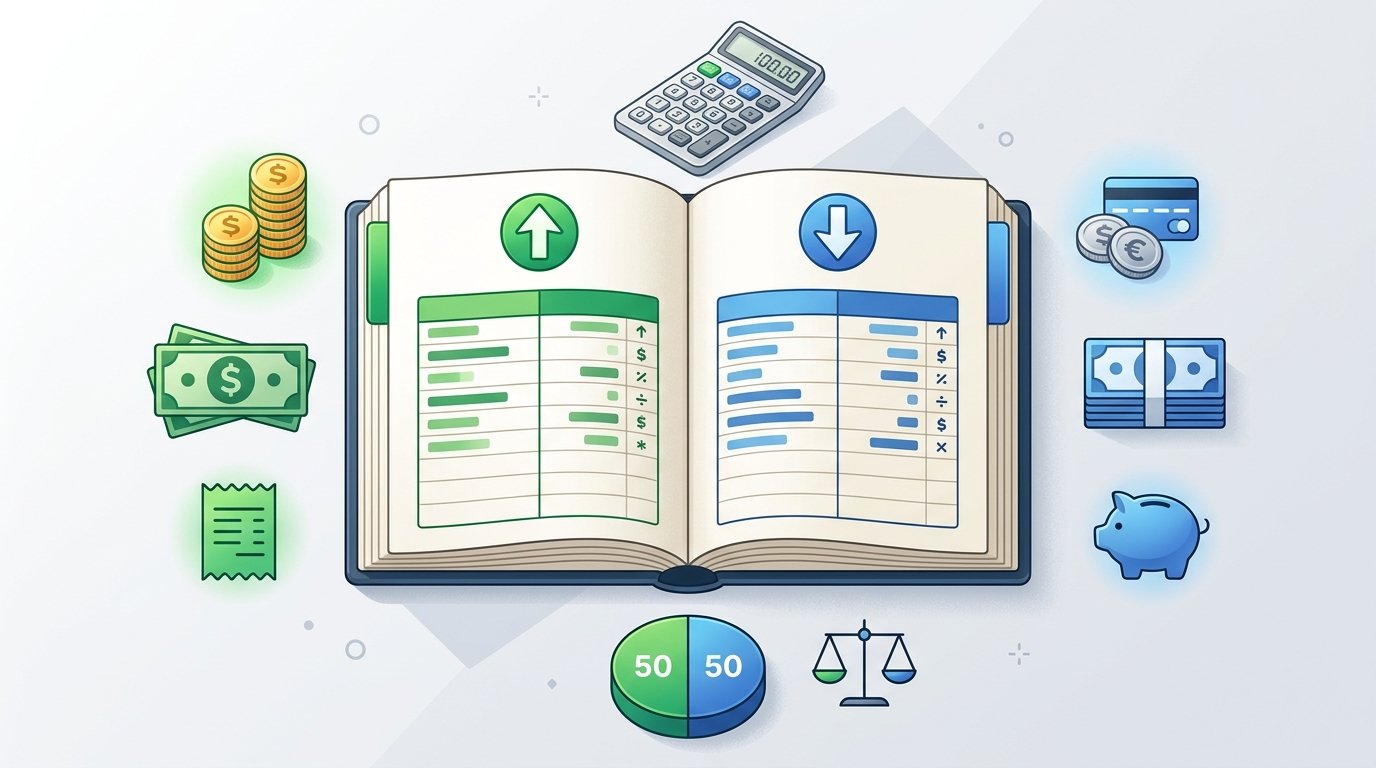
Understanding the Core Concepts of Debits and Credits
Debits and credits form the foundation of accounting. Accountants use them to record every transaction with equal entries on both sides.
This system maintains balance by increasing some accounts while decreasing others. It creates a complete financial picture of business activities.
Definition of Debits and Credits
A debit means an entry on the left side of an account. A credit means an entry on the right side.
These terms do not always mean “increase” or “decrease.” The meaning depends on the type of account.
Asset accounts increase with debits and decrease with credits. Liability accounts do the opposite, increasing with credits and decreasing with debits.
Recording debits and credits requires understanding five main account types:
- Assets – increase with debits
- Liabilities – increase with credits
- Equity – increases with credits
- Revenues – increase with credits
- Expenses – increase with debits
“Dr.” stands for debit, and “cr.” stands for credit. A debit balance means total debits exceed total credits in an account. A credit balance means credits are higher than debits.
The Role of Debits and Credits in Double-Entry Accounting
Double-entry accounting requires every transaction to affect at least two accounts. If one account receives a debit, another account receives a credit for the same amount.
This system checks for errors automatically. The total debits must always equal the total credits.
For example, if a business borrows $5,000 from a bank, the Cash account increases by $5,000 (debit). At the same time, the Notes Payable account increases by $5,000 (credit).
The double-entry method tracks both the source and use of money in every transaction.
Debits vs Credits in Everyday Transactions
Debits and credits become clearer when applied to common business transactions. Cash transactions provide simple examples.
When a business receives cash, the Cash account gets debited. When a business pays cash, the Cash account gets credited.
Common transaction patterns:
| Transaction | Debit | Credit |
|---|---|---|
| Customer pays cash for service | Cash | Service Revenue |
| Pay monthly rent | Rent Expense | Cash |
| Purchase supplies with cash | Supplies | Cash |
| Receive bank loan | Cash | Notes Payable |
If a business provides services on credit, it debits Accounts Receivable and credits Service Revenue. When the customer pays later, the business debits Cash and credits Accounts Receivable.
Expense transactions usually involve debiting the expense account. Paying employees means debiting Wages Expense and crediting Cash. When a company owes utilities but has not paid, it debits Utilities Expense and credits Accounts Payable.
How the Double-Entry System Ensures Accuracy
The double-entry system catches errors and helps prevent fraud. Every transaction must be recorded in two places.
This method keeps financial records balanced and creates a clear trail of all business activities.
Explanation of the Double-Entry Bookkeeping Method
Double-entry bookkeeping requires every financial transaction to affect at least two accounts. When a business records a transaction, it enters one debit and one credit of equal amounts.
This system tracks where money comes from and where it goes. For example, if a company buys equipment with cash, it debits the equipment account and credits the cash account.
Both entries happen at the same time in the journal. The ledger organizes these journal entries by account type.
This dual recording makes it hard to lose track of financial transactions. Every dollar appears in two different places.
Businesses of all sizes use double-entry accounting because it gives a complete picture of financial health.
Maintaining Balance with Debits and Credits
The double-entry system keeps the accounting equation balanced: Assets = Liabilities + Equity. Every journal entry must have equal debits and credits.
If debits don’t equal credits, accountants spot the error right away. This detection happens before entries reach the ledger.
Recording transactions with both debits and credits creates an audit trail. Auditors can track changes from the ledger back to the original journal entries. This transparency makes mistakes and fraud harder to hide.
Mathematics of the Double-Entry System
The math behind double-entry accounting uses simple addition and subtraction. For every transaction, the sum of debits must equal the sum of credits.
Basic Double-Entry Formula:
- Total Debits = Total Credits (for each transaction)
- Assets = Liabilities + Equity (always maintained)
When accountants prepare financial statements, they check if total debits equal total credits. If the numbers don’t match, an error exists.
The system also prevents mistakes like recording a transaction only once or entering different amounts for debit and credit. These safeguards make double-entry bookkeeping more reliable than single-entry systems.
The Accounting Equation and Account Types
The accounting equation is the foundation for all financial record-keeping. It shows how business resources connect to their sources of funding.
Every account in a business falls into one of five main categories. Each category follows specific rules about debits and credits.
Assets = Liabilities + Equity: The Accounting Equation
The accounting equation states that Assets = Liabilities + Equity. This formula must always stay in balance.
When a business receives money from a bank loan, both assets (cash) and liabilities (loan payable) increase by the same amount.
Assets are what a business owns or controls. This includes cash, equipment, buildings, inventory, and amounts owed by customers.
Liabilities are what a business owes to others. These include debts like bank loans, amounts owed to suppliers, and wages owed to employees.
Equity is the owner’s stake in the business. It equals the difference between total assets and total liabilities. For corporations, equity includes stockholder investments and retained earnings.
Types of Accounts in Accounting
Accountants organize accounts into five main categories. The first three come from the accounting equation: assets, liabilities, and equity. The other two are revenues and expenses.
Asset accounts track resources the business owns. Examples include Cash, Accounts Receivable, Inventory, Equipment, and Buildings.
Liability accounts track obligations the business owes. These include Accounts Payable, Notes Payable, Wages Payable, and Loans Payable.
Equity accounts track owner investments and earnings kept in the business. These include Owner’s Capital, Common Stock, and Retained Earnings.
Revenue accounts track income earned from business operations. Examples include Sales Revenue, Service Revenue, and Interest Income.
Expense accounts track costs of running the business. Examples include Rent Expense, Wages Expense, Supplies Expense, and Utilities Expense.
Normal Balances and Rules of Debit and Credit
Each account type has a normal balance that shows whether it increases with debits or credits.
| Account Type | Normal Balance | Increases With | Decreases With |
|---|---|---|---|
| Assets | Debit | Debit | Credit |
| Expenses | Debit | Debit | Credit |
| Liabilities | Credit | Credit | Debit |
| Equity | Credit | Credit | Debit |
| Revenues | Credit | Credit | Debit |
Accounts with debit balances (assets and expenses) appear on the left side of the accounting equation. Accounts with credit balances (liabilities, equity, and revenues) appear on the right side.
A helpful memory tool is DEAL for accounts that increase with debits: Dividends, Expenses, Assets, and Losses. GIRLS stands for accounts that increase with credits: Gains, Income, Revenues, Liabilities, and Stockholders’ Equity.
When an asset account like Cash increases, accountants record a debit. When a liability account like Accounts Payable increases, accountants record a credit.
Detailed Look at Account Categories
Each account category follows rules that determine whether it increases with a debit or credit. Assets grow through debits, while liabilities and equity expand through credits.
Asset Accounts and How Debits Affect Them
Asset accounts represent everything a company owns that has value. These include cash, accounts receivable, inventory, equipment, and property.
Assets increase with debits and decrease with credits. When a business receives cash, the accountant debits the cash account.
If a company makes a sale on credit, accounts receivable gets debited. If a company buys equipment for $5,000, the equipment account receives a $5,000 debit.
Common Asset Accounts:
- Cash
- Accounts receivable
- Inventory
- Equipment
- Buildings
- Land
The normal balance for all asset accounts is on the debit side. If an asset account shows a credit balance, it may signal an error.
Liabilities and Credits Explained
Liability accounts track what a company owes to others. These include accounts payable, loan payable, bank loan balances, and wages payable.
Liabilities increase with credits and decrease with debits. When a business takes out a bank loan for $10,000, the loan payable account gets credited for $10,000.
If a company purchases supplies on credit, accounts payable receives a credit entry. Each time the business makes a payment on these obligations, the liability account gets debited.
Common Liability Accounts:
- Accounts payable
- Loan payable
- Bank loan
- Wages payable
- Notes payable
Liability accounts usually have credit balances. The credit side shows the total amount the business owes.
Equity and Its Relationship with Credits
Equity accounts show the owner’s stake in the business. This category includes owner’s capital, retained earnings, and stockholders’ equity for corporations.
Equity increases with credits and decreases with debits. Retained earnings represent profits the company keeps instead of distributing to owners.
When a business earns a profit, accountants credit retained earnings. If owners invest more money into the business, the equity account receives a credit.
Assets show what the company owns, while equity accounts reveal the ownership claim on those assets. When a company builds retained earnings through profits, the credit balance in equity grows.
Drawing accounts and dividend accounts temporarily reduce equity with debit entries before transferring to the main equity accounts at year-end.
Income, Revenue, and Expense Accounts in Practice
Revenue accounts track money earned from business operations. Expense accounts record costs incurred.
Both appear on the income statement and follow specific debit and credit rules that are opposite each other.
How Debits and Credits Impact Revenue Accounts
Revenue accounts include sales revenue and service revenue. These accounts usually have credit balances.
When a business earns revenue, it increases the account with a credit entry.
A company that performs a service for $500 cash makes two entries. It debits Cash for $500 and credits Service Revenue for $500.
Both entries must equal the same amount.
Revenue earned on credit works differently. When a business provides $800 in services and allows the customer to pay later, it debits Accounts Receivable for $800 and credits Service Revenue for $800.
The business records the revenue immediately, even if it hasn’t received the cash.
Normal Revenue Account Activity:
- Credit to increase revenue
- Debit to decrease revenue (returns or adjustments)
Revenue accounts are temporary accounts. At year end, businesses transfer their balances to owner’s equity.
The new year starts with zero balances in all revenue accounts.
Treatment of Expenses and Rent Expense
Expense accounts have debit balances. When a business incurs an expense, it increases the account with a debit entry.
Rent expense is a common example. If a business pays $1,200 for June rent on June 1, it debits Rent Expense for $1,200 and credits Cash for $1,200.
The business recognizes the expense immediately because the rent benefits only the current month.
Prepaid rent requires different treatment. If the $1,200 payment covers July rent, the business debits Prepaid Rent (an asset account) instead.
It records the expense later when July arrives.
Unpaid expenses also need recording. If employees earn $2,000 in wages but won’t be paid until next week, the business debits Wages Expense for $2,000 and credits Wages Payable (a liability) for $2,000.
Understanding Income Accounts and Sales Revenue
Income accounts and revenue accounts refer to the same category. Both track earnings.
Sales revenue tracks income from selling products or merchandise.
A retail store that sells $3,000 worth of goods for cash debits Cash for $3,000 and credits Sales Revenue for $3,000.
This increases both the asset and revenue accounts.
Sales on credit follow the same pattern. A $1,500 sale with 30-day payment terms debits Accounts Receivable and credits Sales Revenue.
The income statement shows the revenue immediately.
All revenue and income accounts flow into the income statement. This report shows total revenues minus total expenses.
The difference determines net income or net loss for the period.
Bookkeeping Workflows and Financial Statement Preparation
The bookkeeping process transforms individual transactions into comprehensive financial statements. This workflow involves recording journal entries, posting to ledger accounts, and creating a trial balance.
The Role of Journal Entries and Ledgers
A journal entry records a business transaction in the accounting system. Each entry includes the date, the accounts affected, the debit and credit amounts, and a brief description.
The general journal captures all transactions in chronological order. When a company receives $1,000 cash from a customer, the bookkeeper debits Cash and credits Accounts Receivable.
When the business pays $500 for supplies, the entry debits Supplies and credits Cash.
Ledger accounts organize these journal entries by account type. The general ledger contains separate pages or sections for each account.
Assets like Cash, Accounts Receivable, and Equipment each have their own ledger pages. Liabilities such as Accounts Payable and Notes Payable appear in separate sections.
Revenue and expense accounts also have individual ledger pages.
Posting to Ledger and Reconciling Accounts
Posting to the ledger transfers information from journal entries into individual account records. The bookkeeper copies each debit and credit from the journal entry to the appropriate ledger account.
This process creates a complete history of all transactions affecting each account.
Each ledger account shows a running balance. When a debit posts to an asset account, the balance increases.
When a credit posts to that asset account, the balance decreases. The opposite applies to liability and equity accounts.
Reconciliation checks that ledger balances match external records. Bank reconciliation compares the Cash ledger balance to the bank statement.
The process identifies outstanding checks, deposits in transit, and bank fees. Accounts receivable reconciliation confirms customer balances match detailed records.
These procedures catch errors before they affect financial statements.
From Trial Balance to Financial Statements
The trial balance lists all ledger accounts and their balances at a specific date. Debit balances appear in one column; credit balances in another.
The total debits must equal total credits, confirming the accounting equation remains balanced.
Adjusting entries update account balances before preparing financial statements. These entries record accrued expenses, prepaid items, depreciation, and unearned revenue.
A business might record wages earned but not yet paid by debiting Wages Expense and crediting Wages Payable.
The adjusted trial balance includes these entries. This adjusted list provides the data needed for financial statements.
The balance sheet pulls asset, liability, and equity balances from the trial balance. The income statement uses revenue and expense account balances.
The cash flow statement analyzes changes in cash accounts and other balance sheet items to show how the business generated and used cash during the period.
Modern Tools and Practical Bookkeeping Techniques
Accounting software automates double-entry bookkeeping and reduces manual errors.
Understanding account types like real accounts (assets and liabilities), personal accounts (people and businesses), and nominal accounts (revenues and expenses) helps classify transactions correctly.
Mastering depreciation tracking, accrued expenses, and audit trails ensures accurate financial records.
Using Accounting Software for Double-Entry Bookkeeping
QuickBooks and Xero handle double-entry bookkeeping automatically. When a user records a $500 sale, these programs create both the debit to cash and the credit to revenue.
The software connects directly to bank accounts through secure feeds. Transactions download automatically each day, reducing data entry time.
Users review and categorize each transaction with a few clicks.
Key features that simplify bookkeeping:
- Automatic transaction matching between bank feeds and recorded entries
- Customizable chart of accounts for different business types
- Built-in tax preparation reports that calculate quarterly obligations
- Mobile apps for recording expenses and invoices on the go
- Real-time balance sheets and profit-loss statements
Most platforms offer guided setup for real accounts (like equipment and buildings), personal accounts (such as customer and supplier balances), and nominal accounts (income and expense categories).
The software prevents common errors by alerting users when debits and credits don’t balance.
Cloud-based systems like Xero allow multiple users to access the same data at once. This feature helps accountants review books or prepare tax returns.
Common Pitfalls and Practice for Beginners
New bookkeepers often confuse which accounts receive debits versus credits. Assets and expenses increase with debits, while liabilities and revenues increase with credits.
Reversing these entries creates imbalances.
Frequent mistakes include:
- Recording personal expenses in business accounts
- Forgetting to categorize transactions, leaving them in “uncategorized”
- Entering the same transaction twice from different sources
- Mixing cash and accrual methods within the same period
- Skipping monthly bank reconciliation
Beginners should practice with sample transactions before recording real business data. Creating test entries for common scenarios builds confidence.
Recording ten practice sales, five expense payments, and two loan transactions helps develop muscle memory.
Weekly reconciliation catches errors early. Comparing the software’s bank balance to the actual bank statement identifies missing or duplicate entries.
Most errors appear within days of occurrence, making them easier to trace and correct.
Setting aside two hours weekly for bookkeeping prevents backlog. Regular practice makes the process faster and more accurate.
How Depreciation, Accruals, and Audit Trails Work
Depreciation spreads the cost of assets over their useful life. For example, a $12,000 computer with a three-year life generates $4,000 in depreciation expense annually.
The software records a monthly debit to Depreciation Expense and a credit to Accumulated Depreciation.
Accrued expenses are costs incurred but not yet paid. When employees work the last week of December but receive payment in January, the business records accrued wages.
It debits Wage Expense and credits Wages Payable to ensure December’s financial statements reflect the actual cost of operations.
Common accrued expenses:
- Unpaid wages for work performed
- Interest on loans accumulated but not due
- Utilities used but not yet billed
- Services received with pending invoices
Audit trails document every transaction’s history. The software timestamps each entry and records which user made changes.
If someone deletes or modifies a transaction, the system keeps a complete log showing the original entry, the change, and when it occurred.
Tax preparation relies on accurate audit trails. Auditors trace specific transactions from bank statements through journal entries to financial reports.
A clear trail proves the business maintained proper records and followed accounting standards.
Frequently Asked Questions
The basics of debits and credits raise common questions for beginners learning double-entry accounting. These answers clarify how to record transactions and apply the fundamental rules that keep financial records balanced.
What do debits and credits mean in accounting?
Debits and credits describe where amounts are recorded in accounting records. A debit is an entry on the left side of an account. A credit is an entry on the right side.
Every transaction requires at least one debit and one credit. The total dollar amount of debits must equal the total dollar amount of credits for each transaction.
These terms do not mean increase or decrease by themselves. Whether a debit or credit increases an account depends on the type of account.
How do debits and credits work in a double-entry journal entry?
Double-entry accounting requires each transaction to affect at least two accounts. The system records one debit entry and one credit entry for every transaction.
When a company borrows $5,000 from a bank, it debits Cash for $5,000 and credits Notes Payable for $5,000.
Some transactions involve more than two accounts. A loan payment of $300 that includes interest would debit Notes Payable and Interest Expense while crediting Cash.
The total debits still equal the total credits.
This method creates an automatic check on accuracy. If the debits and credits do not balance, an error exists in the entry.
How can I tell which accounts are debited and which are credited in a transaction?
The type of account determines whether it receives a debit or credit to increase it. Asset and expense accounts increase with debits.
Liability, equity, and revenue accounts increase with credits.
A helpful memory tool uses the acronyms DEAL and GIRLS. DEAL stands for Dividends, Expenses, Assets, and Losses—all accounts that increase with debits.
GIRLS stands for Gains, Income, Revenues, Liabilities, and Stockholders’ Equity—all accounts that increase with credits.
To decrease an account, use the opposite entry. Since assets increase with debits, they decrease with credits.
Since liabilities increase with credits, they decrease with debits.
The Cash account provides a simple rule. When cash is received, debit Cash. When cash is paid out, credit Cash.
What are clear examples of debits and credits for common business transactions?
If a company performs a service and receives $50 in cash, it debits Cash for $50 and credits Service Revenues for $50.
When a company pays $800 rent for the current month, it debits Rent Expense for $800 and credits Cash for $800.
If a company provides a service worth $400 but allows the customer to pay in 30 days, it debits Accounts Receivable for $400 and credits Service Revenues for $400.
A business that buys $200 of supplies on credit debits Supplies for $200 and credits Accounts Payable for $200.
How do debits and credits affect the balance sheet and income statement?
The balance sheet shows assets, liabilities, and equity.
Assets appear on the left side and usually have debit balances.
Liabilities and equity appear on the right side and usually have credit balances.
When you debit an asset account, you increase that asset on the balance sheet.
When you credit a liability account, you increase that liability on the balance sheet.
The income statement reports revenues and expenses.
Revenue accounts usually have credit balances, so crediting a revenue account increases income.
Expense accounts usually have debit balances, so debiting an expense account increases expenses.
What are the basic rules of debit and credit that beginners should memorize?
Debit means left, and credit means right.
Every transaction must have equal total debits and credits.
Debits increase assets, expenses, and losses. Credits decrease them.
Credits increase liabilities, equity, revenues, and gains. Debits decrease them.
When you receive cash, debit the Cash account.
When you pay out cash, credit the Cash account.
Asset and expense accounts usually have debit balances.
Liability, equity, and revenue accounts usually have credit balances.
Leave a Reply