
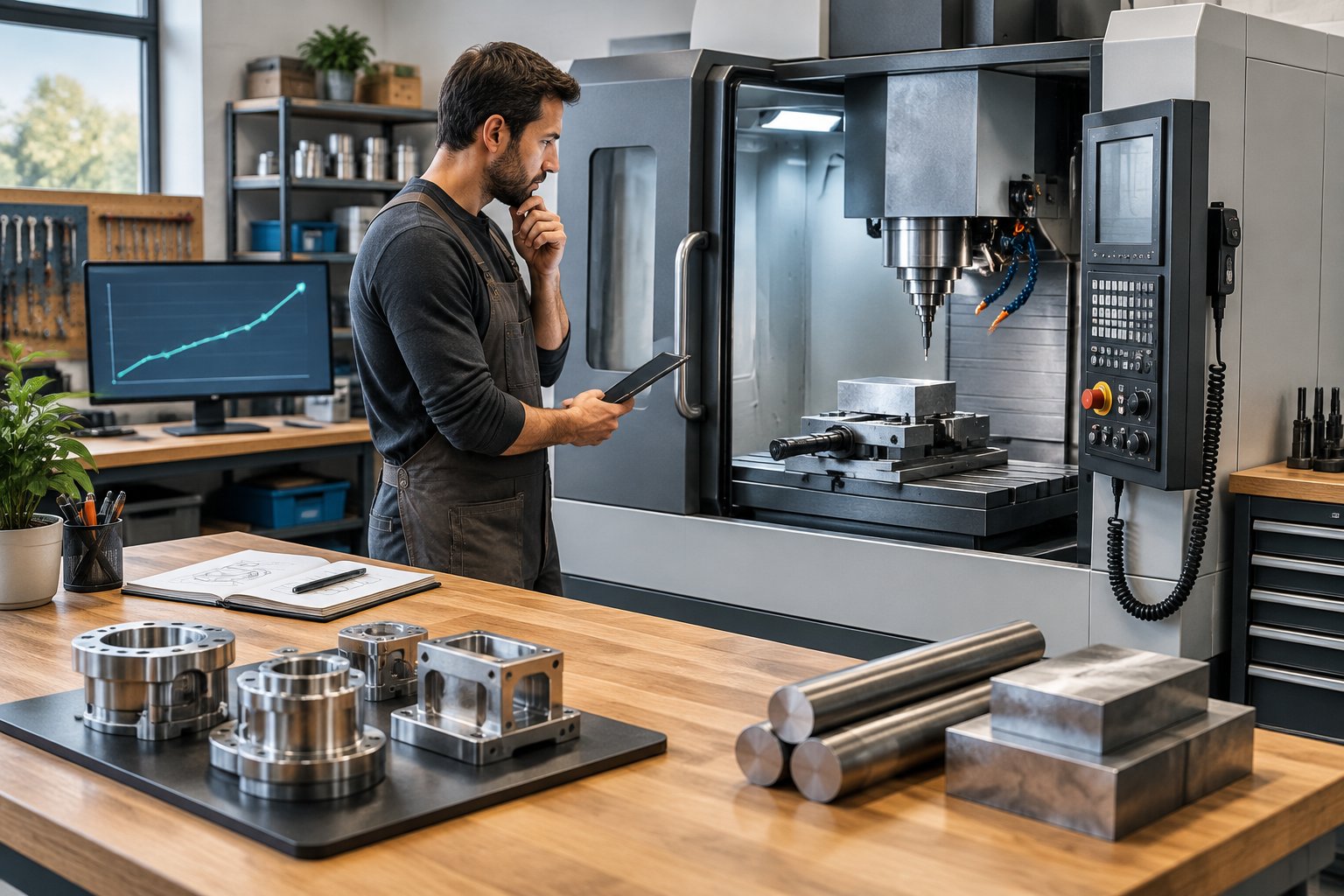
A niche manufacturer rarely fails because the machine was wrong. It fails because the purchase happened before the numbers justified it.
Equipment investment pays off when the annual net benefit it generates, through labour savings, extra capacity, or quality gains, recovers the full installed cost within a timeframe your cash flow can tolerate, typically somewhere between one and five years for small manufacturing operations. That single test matters more than any spec sheet or sales pitch. A shiny new machine with a seven-year payback can sink a small shop just as fast as one that never leaves the showroom.
If you are weighing a manufacturing equipment purchase against the orders actually on your books, the sections below walk through the maths, the hidden costs, and the questions worth answering before you sign a quote. For anyone building the wider financial plan around that decision, it’s also worth getting the bookkeeping and cost tracking right from day one, which is where custom accounting solutions for the manufacturing sector tend to earn their keep.
When Will a Machine Pay for Itself?
A machine pays for itself when cumulative net benefits equal the total amount you spent getting it into production, and in manufacturing that point typically lands between 18 months and 5 years depending on the asset class. Equipment roi and payback period are related but distinct: ROI tells you the percentage return, payback period tells you the calendar time. Both deserve a look before you commit capital.
How Do You Calculate Equipment ROI and Simple Payback?
Simple payback period divides the initial investment by the annual net benefit. If a machine costs $20,000 and generates $15,000 a year in net profit through labour savings and added sales, payback lands at 1.33 years.
Total ROI calculation takes it further: subtract the initial investment from total net benefit over the equipment’s life, then divide by the initial investment. A $20,000 machine delivering $15,000 a year for five years returns $75,000 against a $20,000 outlay, a total ROI of 275%. An equipment roi calculator speeds this up, but the inputs (true cost, realistic net benefit) matter more than the tool itself.
What Does a CNC Job-Shop Example Show?
A CNC machine priced at roughly $150,000 to $300,000 installed can pay back in 18 months to 4 years for a job shop running steady work. Shops in this category typically report revenue of $150,000 to $400,000 and net margins of 15% to 35%, so the payback window hinges heavily on utilisation. A machine sitting idle three days a week pushes payback years further out than the vendor’s brochure implies.
When Does Uneven Cash Flow Change the Payback Date?
Payback dates shift when net benefit doesn’t arrive in equal monthly instalments. A new job shop often sees thin cash flow in month one while customers are onboarded, then a ramp toward full capacity by month six or eight. Mapping monthly cash flow, not just an annual average, shows the real date the investment turns cash-positive rather than an optimistic estimate based on best-case output.
What Is the Full Cost of Getting Equipment into Production?
The full cost of equipment typically runs well above the sticker price, with purchase price representing only a third to half of true total cost of ownership once installation, training, operation, and maintenance are counted. Treating the invoice total as “the cost” is the single most common mistake in equipment financing decisions.
Which Purchase, Installation and Training Costs Belong in the Budget?
Capital expenditure on a machine should include the purchase price, delivery, site preparation, utility connections, and integration with existing floor equipment. Operator training and the productivity dip during the learning curve belong in the same budget line, not treated as an afterthought once the machine arrives. For large equipment, 90% of the money is often out the door before installation even finishes, so financing needs to cover progress payments, not just the final invoice.
How Much Will Operation, Maintenance and Downtime Cost?
Operational costs include energy draw, consumables, and preventive maintenance, and these categories are the most commonly underestimated in a capex proposal. A machine running at 80% uptime instead of 90% loses meaningful throughput even when both are rated for identical output on paper. Request service history from the seller and, where feasible, speak with existing owners of the same model rather than relying on the vendor’s maintenance estimates alone.
How Do Financing and Resale Value Affect the Numbers?
Equipment financing terms and end-of-life resale value both move the real cost up or down. Buying tends to make more sense when the equipment holds value over a decade or more and you have taxable income to shelter through Section 179 or bonus depreciation; leasing tends to suit equipment that becomes outdated quickly or periods when cash needs to stay free for growth. Comparing the net present value of financed ownership against a lease, factoring in the time value of money, gives a cleaner answer than intuition alone.
Which Benefits Can a Specialist Manufacturer Actually Capture?
A specialist manufacturer captures value through faster production, lower labour cost per unit, tighter quality control, and fewer safety incidents, and each of those converts into cash differently. Competing on price alone rarely survives against a generalist shop with lower overhead, so the benefits that matter most are the ones tied to specialisation.
Will Faster Production Lead to Profitable Orders?
Faster cycle times only help if there’s demand to absorb the extra capacity. Production efficiency gains sitting unsold on a shop floor generate nothing; they need orders behind them. A niche manufacturer with a backlog of work converts speed directly into revenue, while one still building a customer base should treat efficiency gains as potential, not booked profit.
When Do Labour Savings and Quality Gains Become Cash Benefits?
Labour savings become cash the moment a machine lets you redeploy a worker to revenue-generating tasks or avoid a hire you would otherwise need. Quality improvement becomes cash more gradually, through fewer reworks, lower scrap rates, and the premium pricing that specialist buyers pay for certified, tight-tolerance work. Aerospace and medical device buyers, for instance, pay more for suppliers who can prove consistent tolerances, which shows up in margin rather than a single line item.
How Should Safety and Reliability Improvements Be Assessed?
Workplace safety improvements should be assessed against the cost of incidents avoided: insurance claims, lost production days, and compliance penalties. Reliability improvements compound this by reducing unplanned downtime, which has both a direct cost in lost output and an indirect cost in expediting fees and strained customer relationships. These benefits rarely appear on a vendor’s ROI sheet, so build them into your own case.
How Do You Decide Whether to Buy Now?
You buy now when demand for the added capacity is already proven, not projected, and the return on investment clears your cost of capital even under a slower-than-planned ramp-up. Manufacturers surveyed on equipment decisions cite staying competitive and cutting labour costs as the top two reasons to invest, but financing constraints and uncertainty about actual benefit are the two most common reasons they hold back.
Is Demand Proven for the Capacity You Plan to Add?
Proven demand means signed orders, a waiting list, or a contract you currently turn away because you lack the capacity to fulfil it. Buying equipment ahead of that proof, on the hope that capacity creates its own demand, is the riskiest version of this decision. A CNC shop with three months of backlog and more enquiries than it can quote is in a different position to one hoping new capability will attract first-time customers.
What Happens to Returns if Ramp-Up Is Slower Than Expected?
Returns stretch significantly if ramp-up takes longer than projected, because payback period is driven by monthly net benefit, not an annual average. A machine modelled to hit full utilisation by month three but actually reaching it by month nine pushes payback out by roughly the same gap. Run the numbers at 50% and 75% of projected utilisation before committing, not just at the vendor’s best-case figure.
When Should You Compare NPV and IRR with the Cost of Capital?
Compare net present value (NPV) and internal rate of return (IRR) against your cost of capital whenever the purchase is large enough that simple payback alone feels too crude. If the IRR on the equipment investment sits below what it costs you to borrow or raise the money, the purchase destroys value even with a payback period that looks acceptable on paper. This calculation matters most for six-figure purchases where financing terms and tax treatment meaningfully shift the outcome, and it pairs well with a broader look at mastering investment decisions through payback period calculation.
Buy the Machine When the Orders and Numbers Support It
The equipment purchase that pays off is the one bought against proven demand, a full cost picture, and a payback period your cash flow can survive, not the one bought because a competitor just upgraded. Treat the vendor’s ROI figures as a starting estimate rather than a final answer, and run your own numbers using your actual utilisation, financing terms, and maintenance history.
A niche manufacturer that waits for signed orders before buying almost always outperforms one that buys on optimism. Getting the full cost of ownership, financing structure, and realistic ramp-up modelled properly before you sign is the work that separates a profitable purchase from an expensive lesson, and it’s exactly the kind of planning custom accounting solutions for the manufacturing sector are built to support.
Frequently Asked Questions
What is a realistic payback period for a small manufacturing business?
A realistic payback period for most small manufacturing equipment sits between 18 months and 5 years, with CNC machinery often landing toward the shorter end when utilisation is strong. Typical machine tool investments run on a three-to-five-year payback cycle, so anything stretching beyond five years deserves a second look at your throughput assumptions. Shorter payback windows usually signal steady, proven demand rather than speculative capacity.
Can a niche manufacturing business start with used equipment?
Yes, used equipment can cut your initial investment significantly, particularly for standard machines with a 15-year or longer lifespan still carrying 10 useful years. Factor in the maintenance and downtime risk that comes with an older asset, since service history and parts availability vary widely between sellers. A well-maintained used CNC machine with documented service records can be a sound way to enter a niche without the full cost of new equipment.
Should a new job shop buy a CNC machine before securing customers?
Buying before customers are secured is the riskiest sequence, since payback depends entirely on booked work rather than projected demand. A stronger approach secures at least a partial order book or firm letters of intent before signing for a machine costing six figures. Shops that buy ahead of demand often end up financing an idle asset while chasing the orders that were supposed to justify it.
Is leasing equipment better than buying it for a new manufacturer?
Leasing suits equipment that becomes outdated quickly or periods when cash needs to stay free for growth, while buying suits equipment you’ll run for a decade and have taxable income to offset through depreciation. Roughly 8 in 10 U.S. businesses use some form of financing or leasing for equipment, so neither choice is unusual. The better option depends on your tax position, cash flow, and how long the machine will stay competitive, which an NPV comparison answers more reliably than instinct.
Which niche manufacturing ideas need a moderate equipment investment?
Small-batch production such as food products, candles, or specialty components often starts with equipment costs in the $50,000 to $100,000 range, while CNC-based or assembly-line manufacturing typically requires $250,000 to $1 million. Choosing a niche where your existing skills and customer relationships are strongest tends to shorten the payback period, since you reach full utilisation faster. Specialising around a proven area of demand, rather than general-purpose capability, usually produces the clearest equipment investment case.
Leave a Reply