
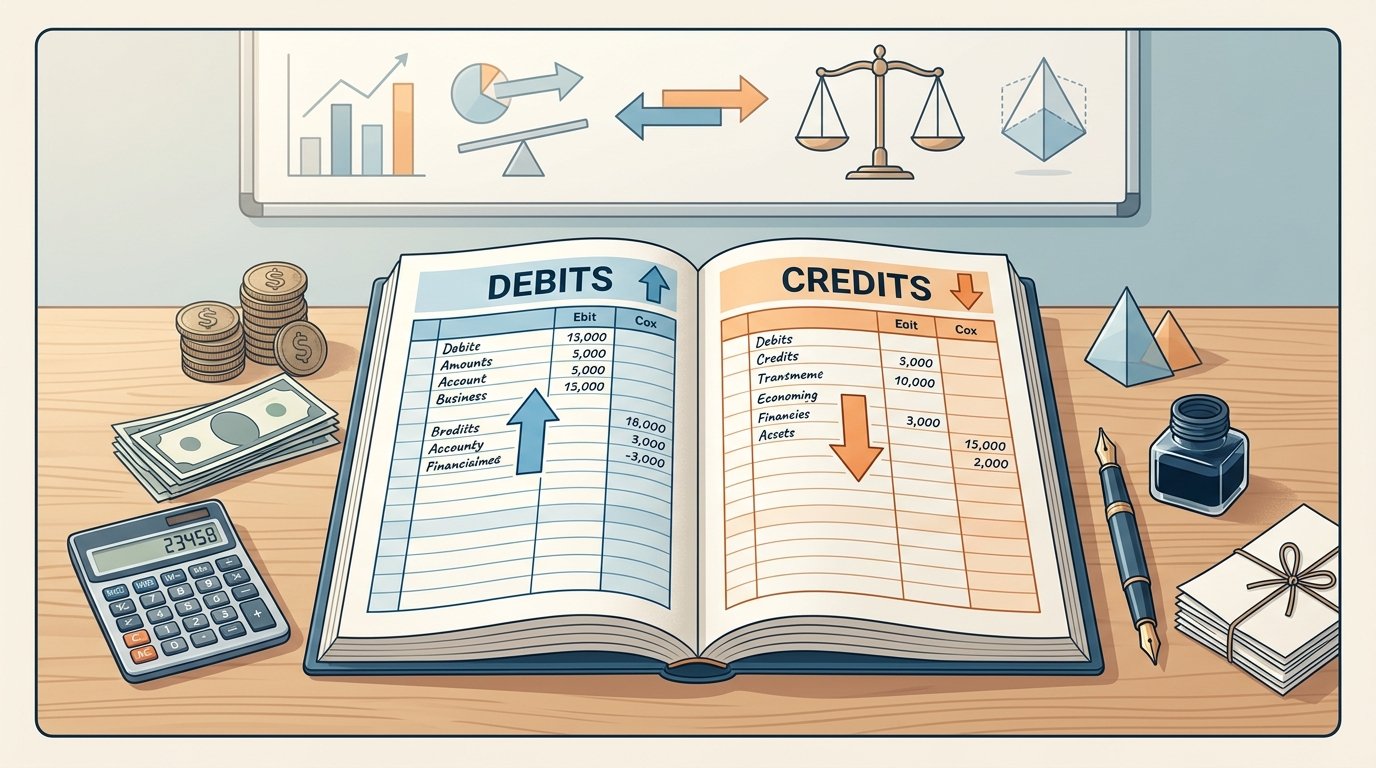
The Essentials of Debits and Credits
Debits and credits form the basic language of accounting. Every financial transaction needs both a debit entry and a credit entry to keep records balanced.
These terms describe the left and right sides of accounts. Knowing which side to use for different account types is key for accurate bookkeeping.
What Are Debits and Credits?
Bookkeepers use debits and credits to record transactions in accounting records. A debit is an entry on the left side of an account.
A credit is an entry on the right side of an account. Every transaction must include at least one debit and one credit.
The total dollar amount of debits must equal the total dollar amount of credits. This system keeps accounting records accurate and balanced.
“Debit” and “credit” do not always mean “increase” or “decrease.” For some accounts, debits increase the balance.
For other accounts, credits increase the balance. The effect depends on the type of account.
The abbreviation for debit is “dr.” The abbreviation for credit is “cr.”
Debit Side vs. Credit Side: The Core Difference
The main difference between debits and credits is which types of accounts they increase. Debits increase some accounts, while credits increase others.
Accounts increased by debits:
- Assets (Cash, Accounts Receivable, Equipment, Supplies)
- Expenses (Rent Expense, Wages Expense, Utilities Expense)
- Dividends or Owner Draws
- Losses
Accounts increased by credits:
- Liabilities (Accounts Payable, Notes Payable, Loans)
- Owner’s Equity or Stockholders’ Equity
- Revenues (Sales, Service Revenue, Interest Income)
- Gains
To decrease an account, use the opposite entry. If a debit increases an asset account, a credit decreases it.
A helpful memory tool is DEAL for accounts increased by debits (Dividends, Expenses, Assets, Losses). GIRLS helps you remember accounts increased by credits (Gains, Income, Revenues, Liabilities, Stockholders’ Equity).
How Debits and Credits Work in Double-Entry Bookkeeping
Double-entry bookkeeping always affects at least two accounts. One account gets a debit entry, and another account gets a credit entry for the same dollar amount.
When a company receives $1,000 cash from a customer, it debits the Cash account (an asset) for $1,000 and credits the Accounts Receivable account for $1,000. When a company pays $500 for rent, it debits the Rent Expense account for $500 and credits the Cash account for $500.
This system checks accuracy automatically. If debits and credits do not match, an error exists in the records.
Simple rule for cash transactions:
- Cash received = debit Cash
- Cash paid out = credit Cash
This double-entry system keeps the accounting equation (Assets = Liabilities + Equity) balanced after every transaction.
Understanding Account Types and Their Normal Balances
Every account in the chart of accounts fits into a category that decides whether it has a normal debit or credit balance. These categories follow consistent rules that support the double-entry system.
Asset Accounts and the Normal Debit Balance
Asset accounts show what a company owns or controls. These include Cash, Accounts Receivable, Inventory, Equipment, Buildings, and Prepaid Rent.
All asset accounts have a normal debit balance. When an asset increases, you debit the account.
When an asset decreases, you credit the account. For example, if a business receives $1,000 in cash, it debits the Cash account for $1,000.
If the business pays out $300, it credits the Cash account for $300. Asset accounts usually show debit amounts in the general ledger.
A company’s bank account, supplies on hand, and equipment all keep debit balances under normal circumstances. If an asset account shows a credit balance, the bookkeeping likely contains an error.
Liability and Equity Accounts: Normal Credit Balance
Liability accounts track what a company owes to others. Common examples are Accounts Payable, Notes Payable, Wages Payable, and Interest Payable.
Equity accounts show the owner’s stake in the business through Owner’s Capital, Common Stock, and Retained Earnings. Both liability and equity accounts have a normal credit balance.
When these accounts increase, you credit them. When they decrease, you debit them.
A $5,000 bank loan increases Notes Payable with a credit entry. Paying back $2,000 of that loan decreases Notes Payable with a debit entry.
These credit balances show claims against the company’s assets. The accounting equation (Assets = Liabilities + Equity) explains why assets are on the opposite side from liabilities and equity.
Revenue, Expense, and Contra Accounts Explained
Revenue accounts like Sales, Service Revenue, and Interest Income have a normal credit balance. When a company earns revenue, it credits the revenue account.
Expense accounts such as Rent Expense, Wages Expense, and Supplies Expense have a normal debit balance. When a company incurs an expense, it debits the expense account.
Contra accounts work opposite to their related accounts. Sales Returns and Sales Allowances are contra revenue accounts with debit balances.
Accumulated Depreciation is a contra asset account with a credit balance. These accounts reduce the balance of their associated main accounts.
Temporary vs. Permanent Accounts
Permanent accounts keep their balances from year to year. These include all asset accounts, liability accounts, and most equity accounts.
A company’s Cash balance at the end of December becomes the beginning balance in January. Temporary accounts reset to zero at the end of each accounting period.
Revenue accounts, expense accounts, and the owner’s drawing account are all temporary accounts. Their balances transfer to equity accounts through closing entries.
Permanent accounts appear on the balance sheet. Temporary accounts collect information during the year for the income statement and then close out so the next period starts at zero.
Applying the Accounting Equation
The accounting equation forms the foundation of every financial transaction a business records. This equation keeps debits and credits balanced across all accounts.
Assets = Liabilities + Equity
The basic accounting equation states: Assets = Liabilities + Equity. This formula shows that everything a company owns must be financed by borrowing or by owner contributions.
Assets include cash, inventory, equipment, and accounts receivable. These are resources the business controls.
Liabilities are what the business owes to others. Common examples are loans, accounts payable, and wages owed.
Equity is the owner’s stake in the business. It includes investments and profits the business has kept over time.
When a business records any transaction, both sides of the equation must stay equal. If assets increase by $1,000, then liabilities, equity, or both must also increase by $1,000.
Impact on Balance Sheet and Income Statement
The accounting equation shapes how financial statements show a company’s financial position. The balance sheet displays assets on one side and liabilities plus equity on the other.
Every transaction affects at least two accounts. When a company buys equipment with cash, one asset increases while another decreases.
The equation stays balanced. The income statement connects to the accounting equation through retained earnings.
When a company earns revenue, equity increases. When it incurs expenses, equity decreases.
At the end of each period, net income from the income statement goes into retained earnings on the balance sheet. This connection links the two main financial statements.
Expanded Accounting Equation With Revenues and Expenses
The expanded accounting equation breaks down equity into its parts: Assets = Liabilities + Owner’s Capital + Revenues – Expenses – Withdrawals. This version shows how daily business activities affect the equation.
Revenues increase equity when a business earns money from sales or services. A $500 sale increases both assets (cash or accounts receivable) and equity through revenues.
Expenses decrease equity when a business spends money to operate. Paying $200 for utilities reduces both assets (cash) and equity through expenses.
The difference between revenues and expenses creates net income or net loss. Net income increases retained earnings, which is part of equity.
Owner withdrawals also reduce equity but do not appear on the income statement. They represent distributions to owners.
Recording Transactions the Right Way
Recording transactions accurately means following rules about when to use debits and credits. Each transaction should be documented in a journal entry.
Organize accounts in a structured system to create a clear audit trail.
Rules for Debits and Credits: Common Mnemonics and Memory Aids
The most popular memory aid for remembering which accounts increase with debits is DEAL: Dividends, Expenses, Assets, and Losses. When a business pays rent or buys equipment, it debits these accounts because debits increase expenses and assets.
For accounts that increase with credits, many accountants use GIRLS: Gains, Income, Revenues, Liabilities, and Stockholders’ Equity. Credits increase liabilities when a company takes out a loan, and credits increase revenue when it makes a sale.
To decrease any account, do the opposite of what increases it. Assets go up with debits, so they go down with credits.
Liabilities go up with credits, so they go down with debits. Another simple rule helps with cash transactions.
When cash comes in, debit the Cash account. When cash goes out, credit the Cash account.
Using Journal Entries to Track Business Activity
A journal entry records every business transaction by showing which accounts increase and which decrease. Each entry includes the date, the accounts affected, and the dollar amounts.
List the accounts to be debited first. List the accounts to be credited below, slightly indented.
Every journal entry must balance. The total debits must equal the total credits in each transaction.
If a company buys supplies for $300 cash, it debits Supplies for $300 and credits Cash for $300. Recording transactions in journal entries creates a complete audit trail.
Each entry shows what happened, when it happened, and how it affected the accounts. This record helps businesses track their financial activity and provides documentation for tax and financial reviews.
Journal entries also handle transactions that affect more than two accounts. For example, a loan payment of $500 might include $450 to Notes Payable and $50 to Interest Expense, with both amounts totaling the $500 credit to Cash.
The Chart of Accounts and General Ledger Structure
The chart of accounts lists every account a business uses to record transactions. It organizes accounts in a standard order: assets, liabilities, equity, revenues, expenses, gains, and losses.
A small business may use about 30 accounts. A larger company may need thousands.
Each account in the chart has a unique number. Asset accounts usually start with 1, liabilities with 2, equity with 3, revenue with 4, and expenses with 5.
This numbering system helps users find accounts and organize financial reports quickly.
The general ledger contains all the accounts from the chart of accounts. Bookkeepers post journal entries to the general ledger by transferring debits and credits to the right account pages.
Each account in the general ledger shows its running balance after every transaction.
The general ledger acts as the main accounting record. Its balances flow into the financial statements.
Visual Tools: T-Accounts and Cheat Sheets
T-accounts turn accounting rules into simple visual diagrams. Cheat sheets and flashcards give quick reference guides to make learning faster.
These tools help students see how double-entry bookkeeping works in minutes.
What Is a T-Account?
A T-account is a visual tool shaped like the letter “T” that represents any individual account. The account name sits at the top.
The left side shows debits, and the right side shows credits.
This layout stays the same for every account type. The T-shape helps track all additions and subtractions in one place.
Each transaction affecting an account goes on the correct side.
The visual format shows how debits and credits work. For asset accounts like cash or inventory, debits on the left increase the balance, while credits on the right decrease it.
Liability and equity accounts work the opposite way. Credits increase these accounts, and debits decrease them.
Revenue accounts increase with credits and decrease with debits. Expense accounts increase with debits and decrease with credits.
The T-account structure makes these patterns clear.
Visual Tutorials and Cheat Sheets for Fast Learning
Visual tutorials use simple diagrams and charts to explain debit and credit rules. Many students remember the DEALER method: Debits increase Expenses, Assets, and Losses, while credits increase Equity, Liabilities, and Revenue.
Cheat sheets organize this information into one-page references. A typical cheat sheet includes:
- Account types with their normal balances
- Rules for increases and decreases for each category
- Sample T-accounts showing common transactions
- Quick reference tables for balance sheet and income statement accounts
These guides help students avoid memorizing abstract rules. Students can check the sheet while recording transactions until the patterns become familiar.
The visual layout groups similar information together. This helps the brain process and remember the material faster.
Sample Flashcards and Quick Tests
Flashcards let students practice T-accounts through active recall. One side shows a transaction, such as “Company receives $5,000 cash from customer.” The other side displays the correct T-accounts with debits and credits.
Students can use physical cards or digital apps. Each card should focus on one transaction type.
Common examples include cash sales, credit purchases, loan payments, and equipment purchases.
Quick tests with coaching give immediate feedback. A basic test might show ten transactions and ask students which accounts increase or decrease.
The coaching explains why each answer is right or wrong. This mix of testing and teaching builds confidence faster than just reading.
Practice tests should start simple and become more complex over time. Early questions may only ask about debit or credit sides. Later questions can require full journal entries with several accounts.
Common Examples and Practical Scenarios
Real transactions follow set patterns once you know how debits and credits affect each account type. The four scenarios below cover the most frequent entries businesses record and show which accounts to debit and credit.
Sales Revenue and Service Revenue Entries
When a business sells a product or provides a service, it records the income earned. For a cash sale, the business debits the cash account and credits sales revenue or service revenue.
If the customer pays later, the business debits accounts receivable instead of cash. The revenue account still gets a credit.
When the customer pays, the business moves the amount from accounts receivable to cash.
Some transactions include sales discounts for early payment. These reduce total revenue.
When a customer takes a discount, the business debits both cash and the sales discounts account. The business credits accounts receivable by the original invoice amount.
| Transaction | Debit | Credit |
|---|---|---|
| Cash sale | Cash | Sales Revenue |
| Credit sale | Accounts Receivable | Service Revenue |
| Payment with discount | Cash + Sales Discounts | Accounts Receivable |
Accounts Payable and Accounts Receivable Transactions
Accounts payable tracks money the business owes to suppliers. When a company receives goods or services on credit, it debits an expense or asset account and credits accounts payable.
Paying the bill later means the business debits accounts payable and credits cash.
Accounts receivable tracks money customers owe the business. Recording a sale on credit creates a debit to accounts receivable and a credit to revenue.
When payment arrives, the business debits cash and credits accounts receivable.
Accounts receivable appears as an asset. Accounts payable appears as a liability. Both affect cash flow when settled.
Handling Rent, Wages, Interest, and Other Expenses
Expense accounts always increase with debits. For rent expense, the business debits rent expense and credits either cash or accounts payable, depending on payment timing.
Wages payable appears when employees have earned pay but haven’t received it yet. The business debits wages expense and credits wages payable.
On payday, the business debits wages payable and credits cash.
Interest expense works the same way. The business records interest expense with a debit and credits either cash or interest payable.
Prepaid expenses are different because payment happens before the expense. The business debits prepaid expenses and credits cash at payment.
Each month, the business transfers a portion from prepaid expenses to expense accounts.
Recording Loans and Notes Payable
When a business takes out a loan, it receives cash, so it debits cash. The business credits loan payable or notes payable to show the new debt.
Loan payments split between principal and interest. The business debits interest expense for the interest portion and debits loan payable for the principal. Both reduce cash with a credit.
Fixed assets often connect to loan entries. Buying equipment with borrowed money means the business debits fixed assets and credits notes payable.
As the asset ages, the business debits depreciation expense and credits accumulated depreciation each month. Accumulated depreciation has a credit balance and reduces the net value of assets on the balance sheet.
Tools, Technology, and Tracking Progress
Modern accounting software automates bookkeeping and gives instant feedback. Printable study materials and progress tracking help students master debits and credits through practice and measurable results.
Accounting Software and Automated Bookkeeping
Accounting software eliminates manual calculations and reduces errors when recording debits and credits.
Programs like QuickBooks, Xero, and FreshBooks automatically update accounts when users enter transactions. These programs show real-time effects on the trial balance.
Most software checks that debits equal credits before saving entries. This instant validation helps learners understand the double-entry system.
Many platforms offer practice environments where students can record transactions without affecting real data. These sandbox features let users experiment and see how each transaction changes assets, liabilities, revenues, and expenses.
The software generates reports showing account balances, transaction histories, and financial statements. Students can review these reports to verify their entries and spot patterns in account behavior.
Printables, PDFs, and Study Materials
Printable PDF files offer offline practice for debits and credits. T-account worksheets let students record transactions and calculate balances by hand.
Reference sheets listing normal account balances and common journal entries serve as quick guides during practice. Students can keep these printables nearby while working.
Chart of accounts templates help learners organize practice problems by account type. These PDFs separate assets, liabilities, equity, revenues, and expenses into sections.
Practice problem sets with answer keys allow independent study. Students record entries and compare their answers to the solutions.
Certificates, Progress Tracking, and Coaching Features
Digital learning platforms track completion rates and quiz scores. Progress tracking shows which concepts students have mastered and which need more practice.
Many courses offer bookkeeping certificates of achievement or excellence after passing final assessments. These certificates show skill in recording transactions and understanding accounting basics.
Activity streaks encourage daily practice by tracking consecutive days of study. Medal rankings and badges provide visual rewards for completing lessons and exercises.
Some platforms include coaching features that give personalized feedback on mistakes. The system spots error patterns and suggests targeted practice in areas like revenue recognition or expense recording.
Frequently Asked Questions
Debits increase asset and expense accounts and decrease liability, equity, and revenue accounts. Credits do the opposite. Every transaction must have equal debits and credits to keep the books balanced.
What is the difference between a debit and a credit in accounting?
A debit records an entry on the left side of an account. A credit records an entry on the right side.
Every transaction records a debit in one account and a matching credit in another.
Debits and credits do not always mean increase or decrease. Their effect depends on the account type.
How do debits and credits affect assets, liabilities, and equity accounts?
Debits increase asset accounts and decrease liability and equity accounts. Credits increase liability and equity accounts and decrease asset accounts.
When a business receives cash, it debits the cash account because assets increase with debits. When the business takes out a loan, it credits the loan payable account because liabilities increase with credits.
Owner’s equity follows the same pattern as liabilities. Credits increase equity accounts when the owner invests money or the business earns profit.
What is the quickest way to determine whether an account should be debited or credited?
Accountants identify the account type first. They then decide if the transaction increases or decreases that account.
Assets and expenses increase with debits and decrease with credits. Liabilities, equity, and revenues increase with credits and decrease with debits.
A simple memory tool is DEALER: Dividends, Expenses, Assets, Losses, Equity Reductions increase with debits.
How do debits and credits work for revenues and expenses in the income statement?
Expense accounts increase with debits and decrease with credits. Revenue accounts increase with credits and decrease with debits.
When a business pays rent, it debits the rent expense account. When the business earns sales income, it credits the sales revenue account.
Expenses reduce profit and equity, which is why they increase with debits. Revenues increase profit and equity, which is why they increase with credits.
How can I use a T-account to verify that a journal entry is correct?
A T-account shows debits on the left and credits on the right of a T-shaped diagram. The account name appears at the top.
Accountants record each side of a transaction in separate T-accounts. They add up both sides to check that total debits equal total credits.
The visual layout makes errors easier to spot. If one side is missing or wrong, the T-accounts will not balance.
T-accounts also show the running balance of each account. This helps track if accounts behave as expected.
What are the most common debit-and-credit mistakes beginners make, and how can they be avoided?
Many beginners confuse debit with decrease and credit with increase. This confusion happens because the words sound similar to everyday language about debt and credit cards.
Beginners often forget that every transaction needs both a debit and a credit entry. Single-sided entries throw off the accounting system and stop the books from balancing.
People also record transactions in the wrong account type. For example, someone might debit an expense when they should debit an asset, or credit revenue when they should credit a liability.
To avoid these mistakes, use a checklist for each entry. Identify the accounts, determine their types, decide if they increase or decrease, and then apply the correct debit or credit rule.
Double-check that debits equal credits before finalizing an entry. This simple step catches most errors.
Leave a Reply