
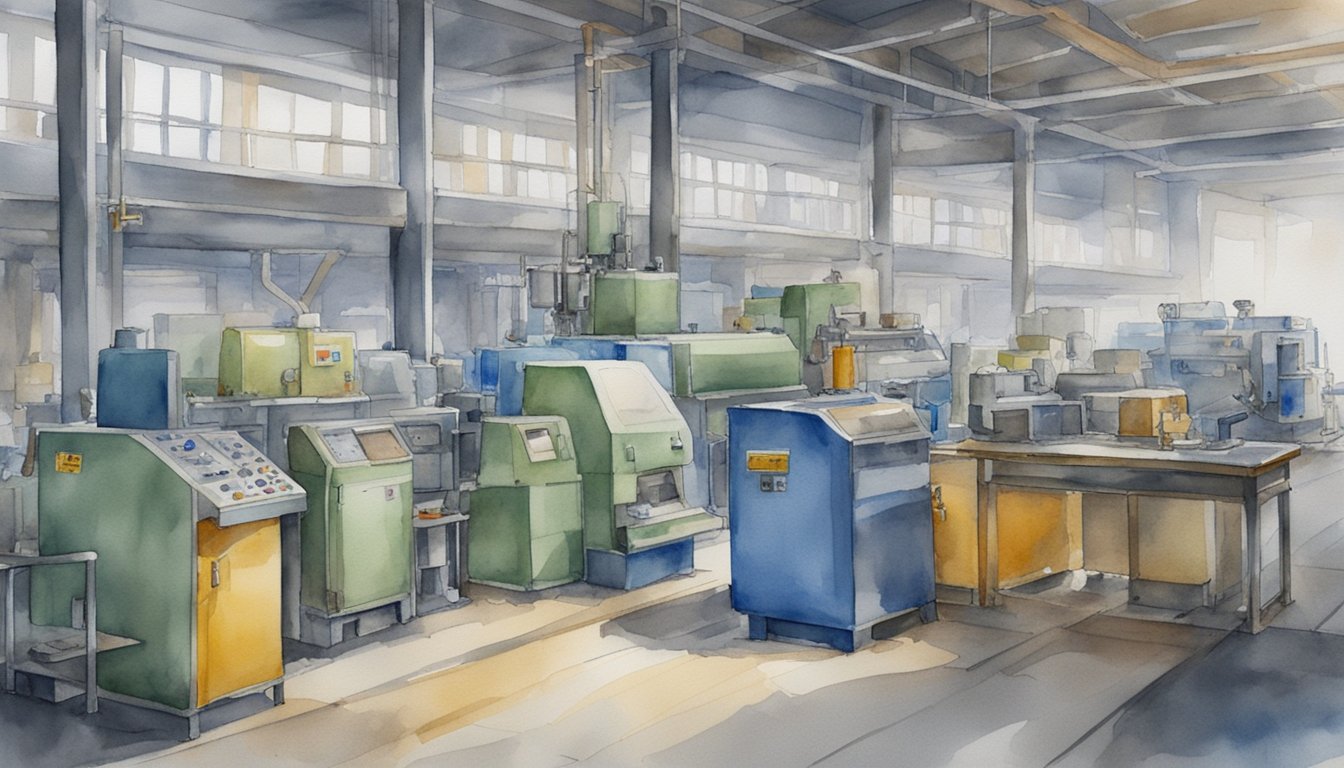
Overview of Equipment Depreciation
Equipment depreciation refers to the gradual decrease in the value of physical assets over time due to regular usage and wear and tear. This concept is crucial in asset management and accounting for manufacturers in the plastics and rubber industry.
- Straight-Line Method: The simplest method to calculate depreciation. Formula: [(Initial Value – Salvage Value) ÷ Useful Life = Annual Depreciation].
For example, a $10,000 machine with a salvage value of $1,000 and a useful life of 9 years would depreciate annually by $1,000.
Units of Production Method:
- Formula: [Depreciation Expense = \frac{(Cost of Asset – Salvage Value)}{Total Estimated Production Capacity} × Units Produced].
Key Concepts:
- Asset: Any equipment that is used in the manufacturing process.
- Useful Life: The estimated period over which an asset is expected to be usable.
- Depreciation Rate: The percentage at which an asset depreciates annually.
- Accumulated Depreciation: The total depreciation expense accumulated over an asset’s life.
Financial Aspects:
- Depreciation Expense: Recorded on financial statements to reflect asset value reduction.
- Tax Purposes: Depreciation reduces taxable income, thus lowering tax liability.
- Financial Health: Regular depreciation assessment helps in understanding the company’s financial health.
Manufacturers must maintain accurate records to ensure compliance and proper asset management. The chosen accounting method directly influences the company’s financial statements and tax obligations. Different methods can be applied based on the nature of the equipment and the industry requirements.
Depreciation Methods and Calculations
Manufacturers in the plastics and rubber industry use various methods to account for equipment depreciation in bookkeeping. These techniques help allocate asset costs over the equipment’s useful life, ensuring accurate financial reports and compliance with tax regulations.
Straight-Line Depreciation Method
Straight-line depreciation is the simplest and most commonly used method. It allocates an equal amount of depreciation expense each year over the asset’s useful life.
- Calculation: Deduct the salvage value from the asset’s cost to find the depreciable base.
- Formula: (Cost of Asset – Salvage Value) / Useful Life.
- Example: An asset costing $50,000 with a salvage value of $5,000 and a useful life of 10 years will have an annual depreciation expense of $4,500.
Accelerated Depreciation Methods
Accelerated depreciation methods allocate higher depreciation expenses in the earlier years of an asset’s life.
- Double Declining Balance Method: This method multiplies the book value at the beginning of each year by twice the straight-line rate.
- Calculation: (2 / Useful Life) x Book Value at the start of the year.
- Benefits: Useful for companies seeking larger tax deductions in the asset’s initial years.
- Example: For an asset with a useful life of 5 years, the depreciation rate would be 40% per year.
Units of Production Method
This method correlates depreciation with actual usage, making it ideal for equipment with varying production volumes.
- Calculation: Determine total production capacity and the units produced in the current year.
- Formula: (Cost of Asset – Salvage Value) / Total Estimated Production Capacity x Units Produced This Year.
- Example: For a machine costing $100,000 with a salvage value of $10,000 and a total estimated capacity of 1,000,000 units, the depreciation expense is calculated based on the units produced each year.
Manufacturers need to choose the appropriate method based on asset usage patterns, production cycles, and financial reporting requirements. These calculations help ensure accurate asset valuation and compliance with accounting standards and tax regulations.
Accounting for Equipment Maintenance
Effective equipment maintenance is key to maintaining asset performance and ensuring accurate bookkeeping in the plastics and rubber industry. Properly managed maintenance can impact decisions on repairs, replacements, and the asset’s net book value.
Role of CMMS Software
Computerized Maintenance Management System (CMMS) software plays a pivotal role in tracking maintenance tasks and managing equipment maintenance records. This software helps in scheduling preventive maintenance, tracking wear and tear, and keeping a detailed maintenance history.
With CMMS software, companies can automate the scheduling of regular inspections and repairs, reducing unexpected equipment failures. It also assists in documenting all maintenance activities, ensuring compliance with accounting standards by clearly showing maintenance costs over time.
Planning for Repairs or Replacement
When equipment breaks down, deciding whether to repair or replace involves careful consideration of costs and asset value. Bookkeeping requires accurate recording of these kinds of decisions, especially their financial impact.
Predictive maintenance strategies help identify potential failures before they occur, aiding in financial decisions. By analyzing maintenance history, companies can decide the most cost-effective option. Capitalizing major repairs that extend the useful life of machinery must align with a company’s capitalization policy.
Tracking Maintenance and Its Effect on Book Value
Tracking maintenance closely ensures that an asset’s net book value reflects its current condition and performance. Regular upkeep keeps equipment operating efficiently, impacting its book value positively by prolonging its useful life.
Recording detailed maintenance history helps in accurate financial reporting. Each maintenance task, whether it’s routine or extensive, must be documented. This meticulous tracking affects the net book value by adjusting depreciation calculations, ensuring the asset’s value is realistic and compliant with accounting principles.
Correctly accounting for these maintenance activities ensures transparency and aids in better decision-making regarding asset management.
Impact on Financial Statements
Depreciation impacts multiple aspects of financial statements, including the balance sheet and income statement.
In the balance sheet, equipment depreciation reduces the asset’s book value. The initial cost of the asset is moved to the accumulated depreciation account. This account reflects the total depreciation expense taken over the years.
Income statements show depreciation as a non-cash expense. It is deducted from revenue to determine the company’s net income. Although depreciation itself does not involve cash outflows, it lowers taxable income, potentially reducing tax liabilities.
The cash flow statement also reveals the effects of depreciation. As a non-cash expense, it is added back to net income in the operating activities section. This adjustment ensures that the cash flows reflect the true cash position of the company.
Depreciation affects shareholder equity too. Reduced asset values lower total assets, which in turn can affect the equity on the balance sheet. Careful management of these figures is crucial for maintaining accurate financial health indicators.
Tax Considerations for Depreciation and Maintenance
Manufacturers in the plastics and rubber industry face specific tax considerations when handling equipment maintenance and depreciation.
Tax Depreciation: Tax depreciation allows businesses to expense equipment over its useful life. This reduces taxable income and thus, tax liability. IRS rules dictate the depreciation methods and schedules that must be followed.
Maintenance Expenses: Routine maintenance and repair costs can often be expensed immediately. IRS guidelines provide for a de minimis safe harbor, allowing for immediate expensing of purchases under $2,500 per invoice. This can go up to $5,000 if the business has an applicable financial statement (AFS).
Impact on Taxable Income: Equipment depreciation and maintenance deductions reduce a company’s taxable income, leading to lower tax payments. This has notable implications for cash flow and budgeting.
Tax and Accounting Purposes: For tax and accounting purposes, companies must differentiate between book and tax depreciation. Book depreciation affects financial statements, reducing reported net income. Tax depreciation, on the other hand, impacts tax filings, reducing taxable income.
| Key Considerations | Details |
|---|---|
| Tax Depreciation | Allows the expensing of equipment over its useful life to reduce taxable income. |
| Maintenance Expenses | Routine repair and maintenance can be expensed immediately under IRS safe harbor rules. |
| Taxable Income Impact | Reduces taxable income, affecting tax liabilities and cash flow. |
| Accounting Differences | Book depreciation impacts financial statements, tax depreciation impacts tax returns. |
These tax considerations necessitate careful planning and adherence to IRS rules to maximize financial efficiency while ensuring compliance.
Asset Lifespan and Depreciation Factors
In the plastics and rubber industry, handling the lifespan and depreciation of equipment involves several key factors. Understanding these factors is critical for accurate financial reporting and maintenance planning.
Age of the equipment plays a significant role. As machinery ages, its value decreases due to wear and tear. This aging process needs to be systematically captured in the books.
Estimated Useful Life is another crucial factor. Manufacturers must determine the period during which equipment will be productive. This estimation is often based on historical data and industry standards.
Wear and Tear is the physical degradation of equipment over time. Regular use impacts functionality, reducing the asset’s lifespan. This natural decline must be accounted for to ensure accurate depreciation.
Salvage Value represents the estimated residual value of the asset at the end of its useful life. For instance, if an asset costing $10,000 has a salvage value of $1,000, the depreciable amount is $9,000.
Obsolescence is also a key consideration. Technological advancements may render equipment obsolete before the end of its physical life. Planning for such scenarios ensures better financial accuracy.
A combination of these factors helps in determining the depreciation method to use, be it straight-line, declining balance, or units of production. Each method provides a different perspective on how the asset’s value declines over its useful life.
By carefully evaluating these elements, manufacturers can manage their equipment maintenance and depreciation more effectively, ensuring their financial statements reflect the true value and status of their assets.
Depreciation for Different Types of Assets
Depreciation is a method used to allocate the cost of a tangible asset over its useful life. This section breaks down how different types of assets are depreciated, focusing on specifics such as equipment used in manufacturing, vehicles, office furniture, and special cases like medical and construction equipment.
Depreciation of Manufacturing Equipment
Manufacturing equipment, including machinery used in the plastics and rubber industry, typically has a significant initial cost and a long useful life. Depreciation for these assets often uses the straight-line method, spreading the cost evenly across its useful life.
For instance, a machine costing $100,000 with a useful life of 10 years and a salvage value of $10,000 would depreciate annually by ($100,000 – $10,000) / 10 = $9,000. Other methods like double-declining balance are also used, particularly where accelerated depreciation is beneficial.
Depreciation of Vehicles and Fleets
Business vehicles and fleets used to transport raw materials or finished products in the industry also depreciate over time. The useful life of these assets typically ranges from 5 to 8 years.
Depreciation can be calculated through the straight-line method or a unit-of-production approach, which ties depreciation expenses to the vehicle’s usage. For example, if a truck costs $50,000, has a salvage value of $5,000, and a useful life of 7 years, its annual depreciation would be ($50,000 – $5,000) / 7 = $6,429. Businesses with heavy transport use may prefer accelerated methods for tax benefits.
Depreciation of Office Furniture and Equipment
Office furniture and equipment, while not exclusive to manufacturing, form a crucial part of the administrative backbone. These assets usually have shorter useful lives, typically between 5 to 7 years.
Office items generally depreciate using the straight-line method. For instance, an office desk costing $2,000 and expected to last 5 years with no salvage value would decrease by $2,000 / 5 = $400 per year. Items may have different depreciation schedules based on their usage and wear.
Special Cases: Medical and Construction Equipment
In the plastics and rubber industry, medical and construction equipment may play specialized roles. Medical equipment, often expensive and used in research, can depreciate over a span of 5 to 10 years. For example, an MRI scanner costing $1,000,000 with a useful life of 10 years might depreciate $100,000 annually, assuming no salvage value.
Construction equipment, essential for setting up or maintaining production environments, usually depreciates over a decade. Heavy-duty machinery costing $500,000 and lasting 10 years with a $50,000 salvage value depreciates by ($500,000 – $50,000) / 10 = $45,000 annually.
Depreciation for these special cases often considers the high initial cost and specific usage patterns, which might require custom depreciation methods for accuracy.
Decision-Making and Strategic Asset Management
Effective decision-making in the plastics and rubber industry relies on comprehensive asset management strategies. Implementing Strategic Asset Management (SAM) ensures that assets are utilized efficiently, maximizing their lifespan and return on investment.
Businesses use forecasting and financial planning to anticipate future costs and asset needs. This includes predicting maintenance schedules and depreciation rates. By planning ahead, companies can allocate funds appropriately, minimizing unexpected expenses.
Stakeholders, including business owners and real estate managers, need accurate data to make informed decisions about equipment maintenance. This data-driven approach helps in aligning maintenance activities with the business cycle, promoting sustainability.
A Strategic Asset Management Plan (SAMP) involves setting clear objectives for maintaining and enhancing asset performance. It coordinates activities like preventive maintenance and timely replacements, improving operational efficiency.
Clear communication among stakeholders is crucial for seamless implementation. Regular updates and reviews ensure that everyone is aware of the asset’s status, facilitating coordinated efforts in asset management.
Incorporating financial, operational, and maintenance best practices supports long-term asset value realization. Using models to track asset performance, companies can adjust strategies as needed to optimize outcomes.
Decision-making becomes more effective when based on accurate, timely information. Developing robust asset management procedures helps businesses achieve sustainability goals while ensuring better returns on investments.
Accounting Principles and Reporting Standards
In the plastics and rubber industry, appropriate accounting principles and reporting standards ensure accurate financial reporting for equipment maintenance and depreciation.
Generally Accepted Accounting Principles (GAAP) serve as the foundation. These principles ensure consistency and transparency in financial statements. Plastics and rubber manufacturers must follow GAAP to present compliant financial reports.
Depreciation Accounting focuses on how the cost of equipment is allocated over its useful life. The matching principle is key here, as it aligns expenses with the revenue they generate. This practice provides a clearer financial picture of the equipment’s value over time.
Various methods of depreciation can be used, such as straight-line depreciation and declining balance depreciation. Selection of the method must reflect the equipment’s usage pattern. For instance, if an asset’s utility diminishes over time, an accelerated method might be more appropriate.
Regular updates in Financial Reporting Standards (FRS), including those issued by the International Financial Reporting Standards (IFRS) and Financial Accounting Standards Board (FASB), influence the treatment of maintenance and depreciation. These updates ensure best practices in financial transparency and accountability.
Adherence to these standards is crucial for compliance and for providing stakeholders with reliable financial data. This includes itemizing direct and indirect costs associated with maintenance and appropriate management of depreciation schedules.
Accurate financial records facilitate informed decision-making, helping manufacturers allocate resources effectively and maintain equipment. This improves overall operational efficiency and ensures long-term profitability.
Frequently Asked Questions
Manufacturers in the plastics and rubber industry must carefully manage the bookkeeping for equipment maintenance and depreciation to ensure accurate financial reporting and compliance with regulatory requirements.
How is equipment depreciation calculated in the plastics and rubber manufacturing industry?
The simplest method to calculate equipment depreciation is the straight-line method. The formula is: (Initial Value – Salvage Value) ÷ Useful Life = Annual Depreciation. This method evenly allocates the cost of the equipment over its useful life, aiding in consistent financial planning.
What accounting entries are required for maintenance costs of manufacturing equipment?
Maintenance costs that do not extend the useful life of the equipment are recorded as expenses. For significant repairs that prolong the useful life, the costs should be capitalized and depreciated over the extended life. Regular expenses are charged as they incur, while capitalized repair costs follow asset depreciation rules.
Which depreciation method is most commonly used for manufacturing assets in the plastics industry?
The straight-line depreciation method is the most commonly used due to its simplicity and ease of application. It spreads the cost evenly over the useful life of the asset, providing predictable annual depreciation expenses.
What is the accounting process for handling equipment maintenance in manufacturing firms?
Routine maintenance expenses are recorded as operational costs in the income statement. If a repair significantly prolongs the equipment’s useful life and meets the capitalization threshold, the expense is capitalized and depreciated. Clear documentation helps in accurate tracking and compliance.
How do manufacturing companies record capital expenditures on equipment?
Capital expenditures on equipment are initially recorded as long-term assets on the balance sheet. The cost is then allocated over the asset’s useful life through periodic depreciation. This process ensures that the expense is matched with the revenue generated by the asset.
What are the typical accounting practices for asset depreciation in the rubber manufacturing sector?
The rubber manufacturing sector often relies on the straight-line method for its simplicity. Companies must factor in wear and tear, obsolescence, and regulatory standards when setting depreciation periods. Maintaining detailed records ensures accuracy and compliance with tax and financial reporting standards.
Leave a Reply