
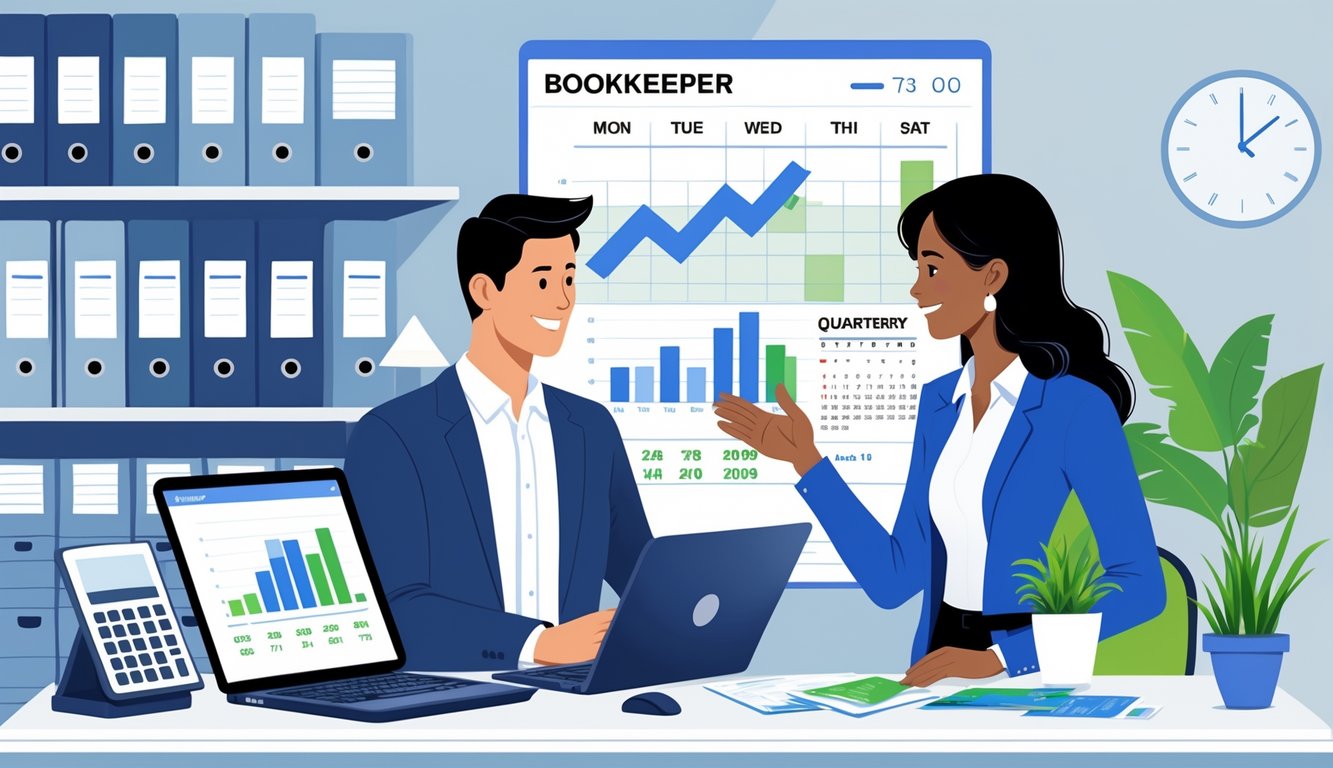
Understanding Quarterly Tax Obligations
Self-employed individuals and small business owners pay estimated tax payments four times a year to meet IRS requirements. These payments cover income and self-employment taxes that an employer would normally withhold.
Consistent tax preparation and timely filing help prevent penalties. They also help maintain accurate financial records.
Who Needs to File Quarterly Taxes
Anyone earning income without employer tax withholding usually needs to pay quarterly taxes. This group includes freelancers, independent contractors, sole proprietors, and single-member LLC owners.
Partners in pass-through entities or people with significant investment or rental income may also need to file. If you expect to owe $1,000 or more in taxes for the year after subtracting credits and withholding, you must make estimated payments.
Those with W-2 wages might still owe quarterly taxes if they have extra side income that increases their tax liability. Bookkeepers should advise clients to review their income regularly.
Changes in contracts, expenses, or business growth can change estimated payment amounts during the year. Tracking income and setting aside tax funds throughout the year keeps cash flow steady and reduces stress when payments are due.
IRS Deadlines and Estimated Tax Payment Schedules
The IRS divides the year into four periods for estimated tax payments. Each due date matches when income is earned.
| Quarter | Income Period | Payment Due Date (2025) |
|---|---|---|
| Q1 | Jan – Mar | April 15, 2025 |
| Q2 | Apr – May | June 17, 2025 |
| Q3 | Jun – Aug | September 16, 2025 |
| Q4 | Sep – Dec | January 15, 2026 |
You can make payments through IRS Direct Pay, EFTPS, or by mailing Form 1040-ES. Each payment should match current earnings to avoid overpaying or underpaying.
Bookkeepers help clients review profit-and-loss statements before each deadline. This process ensures estimated taxes match actual business performance.
Penalties for Non-Compliance
If clients fail to pay quarterly taxes or pay too little, the IRS charges penalties and interest. To avoid these penalties, clients should pay at least 90% of the current year’s total tax or 100% of the prior year’s tax (110% if income exceeded $150,000).
The IRS calculates penalties based on the unpaid amount and the number of days past due. Even late partial payments can trigger charges.
Bookkeepers reduce risk by keeping accurate income records and reminding clients of payment dates. Many professionals use tax software or hire CPAs to calculate precise quarterly amounts.
The Bookkeeper’s Role in Quarterly Tax Management
A professional bookkeeper helps self-employed clients stay compliant with quarterly tax rules by tracking income, expenses, and deadlines. Bookkeepers calculate estimated taxes, work with accountants for accuracy, and communicate schedules clearly.
Guiding Clients Through Estimated Tax Calculations
Bookkeepers use current income and deductible expenses to calculate estimated tax payments. They analyze prior-year tax returns, profit and loss statements, and expense trends to create realistic quarterly estimates.
Accurate forecasting prevents underpayment penalties and helps keep cash flow stable. Many bookkeepers use accounting software to track real-time data, so each payment matches current financial performance.
Bookkeepers adjust figures when clients’ income changes during the year, such as after new contracts or property sales. Common steps include:
- Reviewing year-to-date earnings
- Applying self-employment tax rates
- Including deductions, like equipment or home office use
- Updating the forecast each quarter
Bookkeepers give clients a clear picture of what to pay and when.
Coordinating with Accountants and CPAs
Bookkeepers work with accountants or CPAs to ensure quarterly filings match long-term tax plans. While bookkeepers manage daily financial records, the CPA reviews projections and applies tax law updates.
This teamwork helps catch errors early. Bookkeepers track daily transactions and keep documentation ready for the CPA’s review.
They relay questions about adjustments, deductions, or depreciation so that every report uses correct information. Some bookkeepers keep shared digital records, allowing the CPA to verify data remotely.
This approach keeps everyone working from the same numbers and strengthens compliance across quarters.
Communicating Deadlines to Clients
Clear communication keeps self-employed clients on track with IRS deadlines. Bookkeepers remind clients of payment due dates—usually in April, June, September, and January—and provide worksheets or online reminders showing exact amounts owed.
They explain each deadline’s purpose and the risks of missing one, such as interest or penalty fees. Many use email checklists or secure client portals to share forms, payment methods, and confirmation steps.
Timely updates help clients prepare funds in advance. When a deadline approaches, the bookkeeper confirms that payments have been processed and that receipts or digital confirmations are stored.
This structured communication keeps the tax process organized year-round.
Tracking and Categorizing Business Finances for Tax Purposes
Accurate tracking of business finances supports reliable tax reporting. A structured accounting system helps bookkeepers control financial transactions and simplify quarterly tax calculations.
Setting Up Chart of Accounts
A chart of accounts (COA) organizes all financial data into specific categories. It lists each account in the business ledger, such as assets, liabilities, equity, revenue, and expenses.
Clear labels ensure consistent recordkeeping for income, spending, and obligations. Most bookkeepers divide accounts by type:
| Account Type | Example Accounts | Purpose |
|---|---|---|
| Assets | Cash, Accounts Receivable | Track what the business owns |
| Liabilities | Accounts Payable, Credit Cards | Record what the business owes |
| Revenue | Service Income, Sales Income | Capture all money earned |
| Expenses | Rent, Utilities, Supplies | Track costs tied to operations |
Every transaction should go into the correct account category. Reviewing the COA regularly helps catch duplicate or unused accounts.
Recording Income and Revenue Streams
Bookkeepers record income when it’s earned, not just when funds arrive. This approach matches accrual-based bookkeeping and ensures accurate tax estimates.
Key income categories include service fees, product sales, commissions, and interest income. Clear documentation supports accurate quarterly estimated tax payments.
Tracking accounts receivable—money owed by clients—prevents overlooked income. Simple accounting software or spreadsheets can automate entries and generate revenue summaries.
Supporting details like invoice numbers, payment dates, and customer names help reconcile bank deposits and income reports. Keeping financial records consistent makes it easier to verify revenue totals before preparing quarterly tax forms.
Documenting and Allocating Expenses
Expense tracking helps determine tax deductions and maintain profitability. Bookkeepers record all business expenses—from office supplies and software to mileage and insurance.
Each expense should link to a specific category in the chart of accounts for easy reporting. Examples include:
- Operating expenses: rent, utilities, internet
- Cost of goods sold: materials, production costs
- Administrative expenses: accounting fees, subscriptions
Monitoring accounts payable ensures bills are paid on time. Supporting documents like receipts and vendor invoices validate deductions and serve as proof during audits.
Consistent documentation also helps separate personal and business spending, keeping financial records clean for accurate tax reporting.
Essential Bookkeeping Practices for Self-Employed Clients
Consistent and organized financial tracking supports accurate tax estimates. Reliable records, clear accounting methods, and timely reconciliations create a foundation for good decisions and tax compliance.
Maintaining Accurate Financial Records
Accurate records help self-employed clients see how money flows through their business. Each transaction—income, expense, or withdrawal—should be recorded promptly with the correct date, category, and payment method.
This improves the quality of reports used for quarterly tax estimates. Bookkeeping software with bank reconciliation features keeps accounts current.
It compares bank statements against internal records to reveal missing entries and errors. Monthly reconciliations prevent small mistakes from growing.
A clear recordkeeping system may include:
- Separate business bank account to avoid mixing funds
- Digital receipts and attachments linked to transactions
- Organized chart of accounts aligned with tax categories
Regular monitoring of financial data provides transparency and confidence during audits.
Double-Entry vs. Single-Entry Bookkeeping
The bookkeeping process depends on business complexity. Many freelancers start with single-entry bookkeeping, which logs income and expenses once.
It’s easy to maintain but offers limited insight into financial health. Double-entry bookkeeping records every transaction twice—once as a debit and once as a credit.
This creates balance between assets, liabilities, and equity. It supports detailed reports like balance sheets and profit-and-loss statements.
| Method | Entries per Transaction | Suitable for | Key Advantage |
|---|---|---|---|
| Single-Entry | One | Simple sole proprietors | Fast and easy |
| Double-Entry | Two (Debit/Credit) | Growing businesses | More accurate and comprehensive |
Bookkeepers often choose double-entry when clients handle multiple income sources, assets, or liabilities. It provides stronger financial control and error detection.
Choosing Between Cash and Accrual Accounting
Self-employed clients must choose between cash-based accounting and accrual accounting when setting up their books. Cash-based systems record income only when received and expenses when paid.
This method gives a clear view of cash flow and is easier for small businesses. Accrual accounting records income when earned and expenses when incurred, regardless of payment timing.
It provides a more accurate picture of profitability and matches GAAP standards.
Comparison Summary:
| Accounting Type | When Transactions Are Recorded | Insight Provided | Typical Use |
|---|---|---|---|
| Cash-Based | When cash changes hands | Actual cash flow | Small businesses or contractors |
| Accrual | When income/expenses occur | True profitability | Larger or growing businesses |
The choice affects tax timing and reporting accuracy. Bookkeepers should evaluate client size, complexity, and IRS requirements before selecting the method.
Leveraging Technology for Efficient Tax Preparation
Modern bookkeeping uses digital tools for data entry, expense tracking, and filing tasks. Automation, cloud platforms, and AI-driven features help bookkeepers manage records and reduce manual work.
Popular Bookkeeping and Accounting Software
Reliable accounting software helps bookkeepers organize client data and prepare for quarterly tax filings. Tools like QuickBooks Online, FreshBooks, and Xero let users track income, expenses, and invoices in one place.
These platforms also integrate bank feeds, making reconciliations easier and keeping records consistent.
A comparison of common tools:
| Software | Best For | Key Features |
|---|---|---|
| QuickBooks Online | Freelancers and small businesses | Automated tax estimates, expense tracking, bank feed sync |
| FreshBooks | Service-based businesses | Invoicing, time tracking, simple reports |
| Xero | Growing businesses | Multi-user access, multi-currency support, budget management |
Using these platforms ensures consistent data entry and fast reporting. They also provide updated tax forms and compliance reminders, helping clients avoid late or inaccurate filings.
Integrating Cloud Accounting Tools
Cloud accounting lets bookkeepers manage taxes anywhere using secure online systems. Storing financial data in the cloud allows multiple users to access the same information in real time without exchanging files or spreadsheets.
This setup reduces version errors and supports collaboration between clients and accountants. Cloud tools also offer strong encryption and automatic backups.
Security features protect sensitive tax information and lower the risk of lost data. Many platforms include mobile access through a bookkeeping app, making it easier to review transactions or upload receipts on the go.
Bookkeepers receive cloud-based alerts and reminders for quarterly tax deadlines. These timely notifications help prevent penalties and keep client accounts up to date.
Automated Expense Tracking and Reporting
Modern bookkeeping systems use AI and automation to categorize expenses instantly. When bookkeepers link these tools to bank accounts or business cards, transactions appear automatically.
Bookkeepers can confirm and classify transactions with minimal effort. Expense reports generate in seconds, showing total income, taxable deductions, and potential liabilities.
This automation shortens the time spent on manual calculations and improves reporting accuracy. Some tools identify spending trends and highlight deductible categories like home office costs or vehicle expenses.
Automation allows bookkeepers to focus more on advisory work, helping clients plan better for their next quarterly payment.
Analyzing Financial Reports for Quarterly Tax Planning
Accurate financial reporting and careful review of a client’s financial statements support effective quarterly tax planning. Reliable data identifies taxable income, deductible expenses, and financial changes that affect estimated tax payments.
Preparing Financial Statements
Accurate financial statements form the foundation for tax planning. Bookkeepers prepare income statements, balance sheets, and cash flow statements each quarter to show business performance.
Consistent accounting methods ensure comparability over time. Organizing transactions into categories such as revenue, cost of goods sold, and operating expenses makes it easier to spot tax-deductible items.
Bookkeepers reconcile accounts receivable, accounts payable, and payroll each quarter to prevent errors that could distort taxable income.
Common reports include:
| Report Type | Primary Purpose |
|---|---|
| Income Statement | Shows profitability over a specific period |
| Balance Sheet | Displays assets, liabilities, and equity at a point in time |
| Cash Flow Statement | Tracks cash inflows and outflows |
Utilizing Balance Sheets for Tax Estimates
A balance sheet lists assets, liabilities, and owner’s equity to show financial health. Bookkeepers use this information to check if a business has enough liquidity for estimated taxes without straining cash flow.
Monitoring current assets such as cash, receivables, and inventory helps determine available funds for tax payments. Growth in assets or reduction in liabilities may signal an increase in taxable income.
Rising debt or declining retained earnings might indicate tighter cash flow and the need to adjust estimates. Key ratios from balance sheets—like the current ratio (current assets ÷ current liabilities)—help assess short-term financial stability.
These metrics give useful insights when advising clients on how much to reserve for taxes while keeping operations running smoothly.
Using Profit and Loss Reports to Project Tax Liability
The profit and loss (P&L) report, or income statement, summarizes revenues and expenses for a specific period. It shows the net profit that forms the base for estimating taxable income.
Tracking income categories, such as service revenue or rental income, helps apply the correct tax rates. Detailed expense analysis ensures all legitimate deductions—supplies, utilities, depreciation, and self-employment taxes—are included.
Bookkeepers compare actual results to prior quarters to spot patterns, seasonal changes, or unexpected expenses that might impact future tax liability.
Creating quarterly summaries from the P&L allows for more accurate forecasting. When combined with balance sheet data, it gives a clear picture of current profitability and upcoming tax obligations.
Best Practices for Bookkeepers Serving Self-Employed Clients
Bookkeepers working with self-employed clients handle both daily finances and strategic planning. They balance accurate recordkeeping, compliance with tax rules, and communication across multiple teams and systems.
Maintaining current knowledge and offering tailored bookkeeping services help keep financial operations smooth and compliant.
Offering Basic vs. Advanced Bookkeeping Services
Self-employed clients have different needs, so bookkeepers adjust services according to business size and complexity. Basic bookkeeping services include recording income and expenses, reconciling bank accounts, and organizing receipts for tax preparation.
These services create a solid foundation for compliance and reporting. Advanced services provide cash flow analysis, forecasting, and tax planning support.
A dedicated bookkeeper may help clients estimate and budget for quarterly taxes or suggest tools that automate transaction tracking.
Below is a simple comparison of service levels:
| Service Type | Typical Tasks | Ideal Client |
|---|---|---|
| Basic | Data entry, account reconciliation, expense categorization | Freelancers, startups |
| Advanced | Tax projections, payroll, financial reports | Growing small businesses |
Bookkeepers should explain service distinctions clearly so clients can choose the right level of support.
Staying Current with Tax Laws and Industry Standards
Tax regulations and reporting requirements change often, especially for self-employment income and quarterly estimated tax payments. Bookkeepers review IRS updates and professional guidance to keep every client file compliant.
Subscribing to accounting bulletins and attending training sessions helps bookkeepers stay informed about deductions, thresholds, and safe harbor rules. Using software that updates with current tax law changes reduces manual errors and saves time.
Bookkeepers also review state-level obligations since those can differ from federal rules. Tracking changes regularly ensures accurate service delivery and reduces a client’s audit or penalty risk.
Collaboration with In-House and Outsourced Teams
Bookkeepers coordinate with an in-house bookkeeper, external accountant, or tax preparer. Clear communication helps all parties keep consistent records and aligned financial strategies.
Using shared cloud accounting platforms improves visibility for everyone involved. Strong collaboration benefits small business accounting clients who outsource parts of their bookkeeping.
It keeps data synchronized across payroll, invoicing, and tax software systems. Bookkeepers document workflows, define responsibilities, and use checklists for quarterly reviews.
This structure reduces duplication, boosts accountability, and supports reliable financial reporting throughout the year.
Frequently Asked Questions
Self-employed individuals often face challenges in estimating their taxes, meeting payment deadlines, and understanding IRS requirements. Accurate estimation, timely filing, and awareness of penalties help them stay compliant and avoid unnecessary costs.
How can I accurately estimate my quarterly taxes if I am self-employed?
Start by calculating expected annual income, including all self-employment earnings and additional income sources. Subtract business deductions and allowable adjustments to estimate taxable income.
Apply the correct federal income and self-employment tax rates. Use the IRS Tax Withholding Estimator or Form 1040-ES for better accuracy.
Many bookkeepers recommend setting aside 25–30% of income for combined federal and self-employment taxes to prevent shortfalls.
Are first-year self-employed individuals required to pay quarterly taxes?
Yes, if you expect to owe $1,000 or more in federal taxes after deductions and credits. The IRS requires quarterly estimated payments even during the first year of self-employment.
However, if you had no tax liability in the prior year and were a U.S. resident for the entire year, you may be exempt from making quarterly payments. Planning ahead helps avoid an unexpected balance due at year-end.
What is the correct method to calculate quarterly taxes for an LLC?
For a single-member LLC, the owner pays estimated taxes as a sole proprietor using Schedule C and Schedule SE. Calculate income and self-employment taxes the same way as other self-employed individuals.
A multi-member LLC usually files as a partnership. Each member pays quarterly taxes on their share of business income, reported on a Schedule K-1.
If the LLC elects to be taxed as an S corporation or C corporation, the process changes based on the tax classification.
Can you provide guidance on filing quarterly taxes online for self-employed individuals?
The IRS offers several safe online options. The Electronic Federal Tax Payment System (EFTPS) and the Direct Pay portal are the most common.
These tools let taxpayers schedule payments in advance and receive confirmation receipts. You can also use the IRS2Go app or authorize payments directly from a bank account.
Keeping electronic records of each transaction ensures organized bookkeeping and accurate year-end reconciliation.
What are the penalties for failing to pay quarterly taxes on time?
The IRS charges underpayment penalties and interest on late or missing payments. The penalty amount depends on how much you underpaid and how long the amount remained unpaid.
Even if you pay the full tax balance by April 15, late quarterly payments can still trigger penalties. Paying at least 90% of the current year’s tax liability or 100% of the prior year’s (110% for higher-income taxpayers) usually avoids penalties under the safe harbor rule.
When are the specific due dates for self-employed individuals to pay their quarterly taxes?
For the 2025 tax year, you must make payments on April 15, June 17, September 16, 2025, and January 15, 2026. If a due date falls on a weekend or holiday, you pay on the next business day.
Add these dates to your calendar or accounting system to avoid missing them. Staying organized throughout the year helps you avoid last-minute stress.
Leave a Reply